
JEE Main 8 April 2025 Shift 2: Chemistry Question 68
When
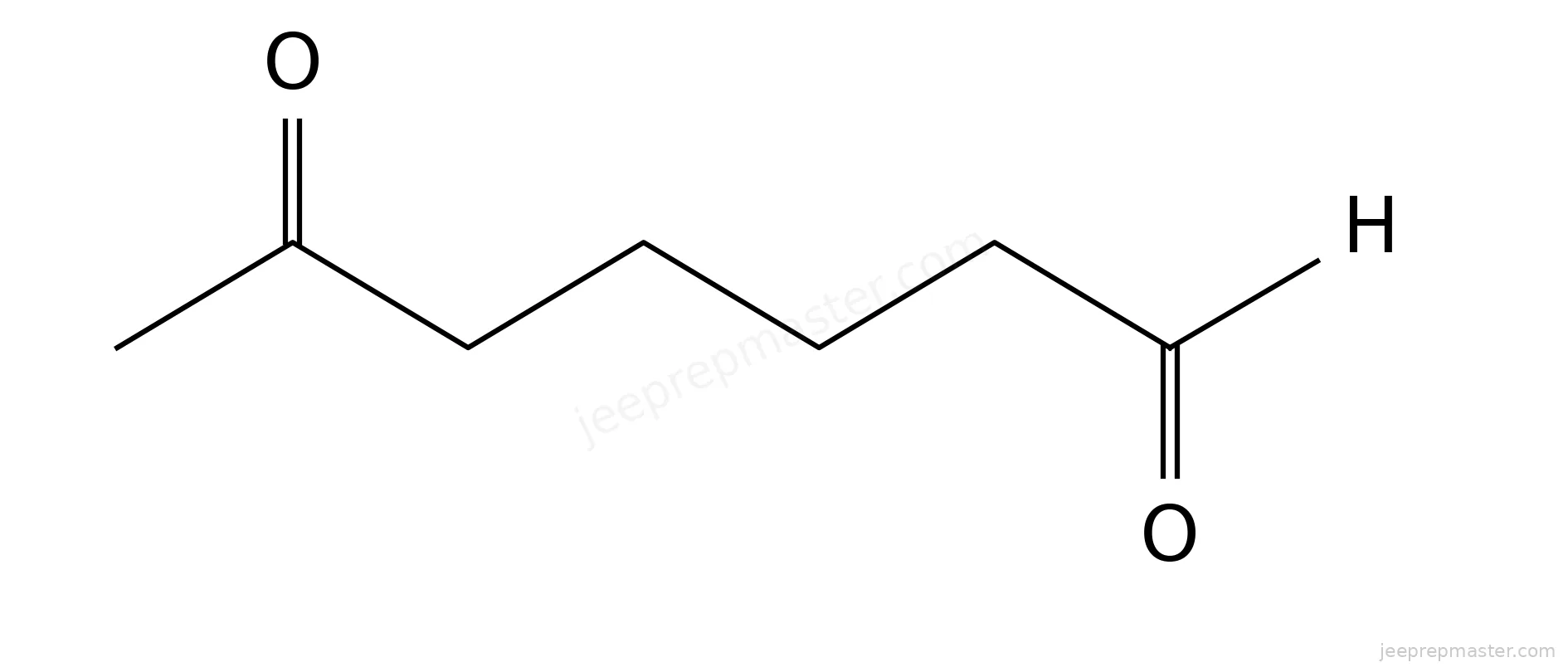
undergoes intramolecular aldol condensation, the major product formed is:
Show answer and solution
Correct answer: Option 3
The starting keto-aldehyde is –CO–––––CHO. Label its carbons from the methyl end C1 through C7, with ketone carbonyl C2 and aldehyde carbonyl C7.
Remove an α-hydrogen from C3 to form the ketone enolate. Intramolecular attack of C3 on the more electrophilic aldehyde carbon C7 creates a C3–C7 bond and a five-membered ring C3–C4–C5–C6–C7. The acetyl group remains attached to C3.
The initial aldol is a β-hydroxy ketone. Dehydration removes OH from the former aldehyde carbon C7 and H from C3, creating the bond conjugated with the retained acetyl carbonyl. The product is 1-acetylcyclopent-1-ene, the structure in option (3).
Attack from the methyl-side enolate C1 would require a seven-membered ring and is less favourable than the five-membered-ring closure. Attack of the aldehyde-side enolate on the ketone would use the less electrophilic ketone as acceptor; this is not the favoured path in the stated major-product comparison.