JEE Prep Master

Reading mode

Text size

JEE Main 5 April 2026 Shift 2: Chemistry Question 66

Aldehydes, Ketones and Carboxylic AcidsSingle correct option+4 / −1

Given below are two statements:

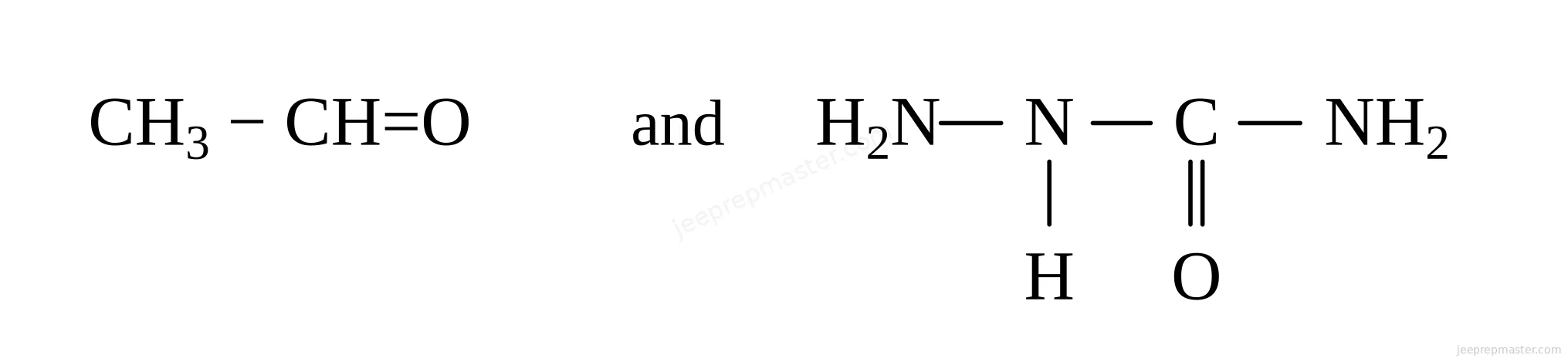
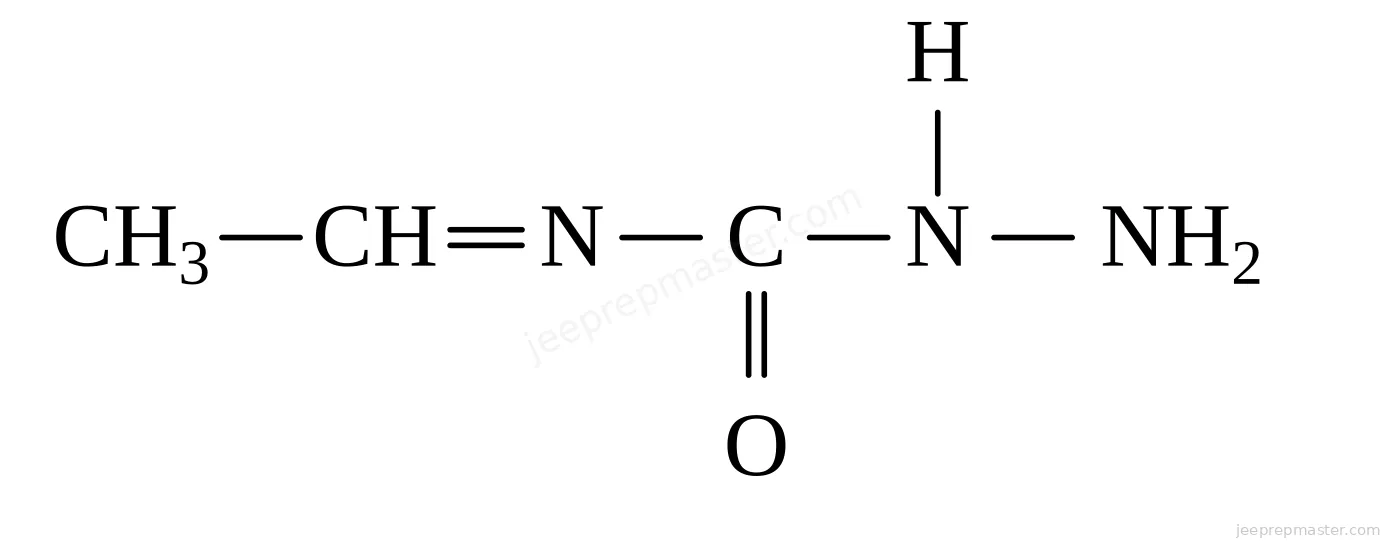
Statement I\text{I}: The condensation reaction between CH3\text{C}\text{H}_{\text{3}}–CH=O\text{CH=O} and H2N\text{H}_{\text{2}}\text{N}–NH\text{NH}–C(=O)\text{C(=O)}–NH2\text{N}\text{H}_{\text{2}} under optimum pH\text{pH} will produce CH3\text{C}\text{H}_{\text{3}}–CH=N\text{CH=N}–C(=O)\text{C(=O)}–NH\text{NH}–NH2\text{N}\text{H}_{\text{2}}.

Statement I reactants: ethanal and semicarbazide, H₂N–NH–C(=O)–NH₂.

Claimed product

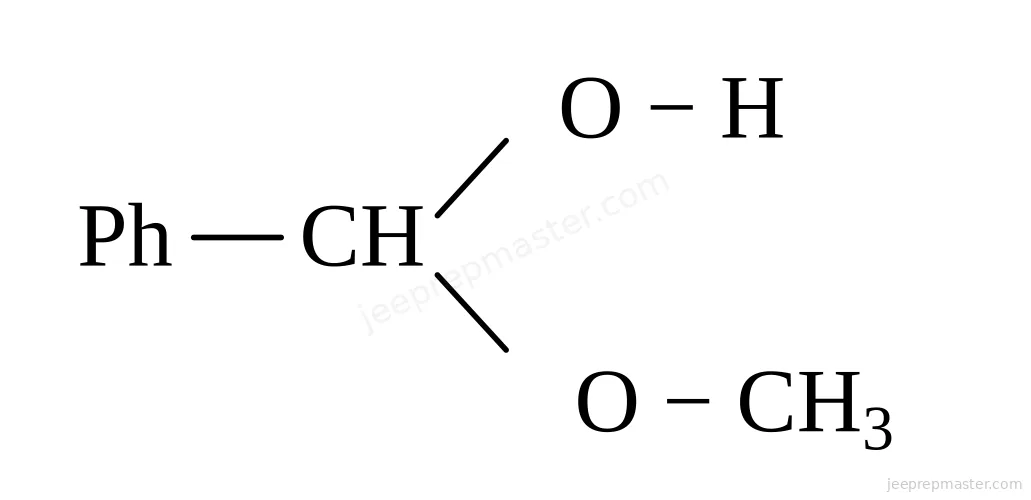
Statement II\text{II}: The molecule, Ph\text{Ph}–CH(OH)(OCH3)\text{CH(OH)(OC}\text{H}_{\text{3}}), will generate Ph\text{Ph}–CH=O\text{CH=O} in the presence of dilute acid.

Statement II structure: Ph–CH(OH)(OCH₃).

In the light of the above statements, choose the correct answer from the options given below:

Show answer and solution

Correct answer: Option 4

The reagent in Statement I is semicarbazide, H2N\text{H}_{\text{2}}\text{N}–NH\text{NH}–C(=O)\text{C(=O)}–NH2\text{N}\text{H}_{\text{2}}. Its terminal hydrazino −NH2-\text{N}\text{H}_{\text{2}} group condenses with the aldehyde carbonyl, eliminating water.

The correct semicarbazone is CH3\text{C}\text{H}_{\text{3}}–CH=N\text{CH=N}–NH\text{NH}–C(=O)\text{C(=O)}–NH2\text{N}\text{H}_{\text{2}}. The product given in Statement I is CH3\text{C}\text{H}_{\text{3}}–CH=N\text{CH=N}–C(=O)\text{C(=O)}–NH\text{NH}–NH2\text{N}\text{H}_{\text{2}}, which has different N/C\text{N/C} connectivity. Therefore Statement I is false.

Ph\text{Ph}–CH(OH)(OCH3)\text{CH(OH)(OC}\text{H}_{\text{3}}) is a hemiacetal. In dilute aqueous acid it reverts to benzaldehyde and methanol: PhCH(OH)(OCH3)\text{PhCH(OH)(OC}\text{H}_{\text{3}}) ⇌ PhCHO + CH3OH\text{PhCHO + C}\text{H}_{\text{3}}\text{OH}. Statement II is true.

Hence Statement I is false but Statement II is true, giving option 4\text{4}. Statement I is false because the displayed product has the wrong connectivity.

More Aldehydes, Ketones and Carboxylic Acids questions

All 49 Aldehydes, Ketones and Carboxylic Acids questions