
JEE Main 29 January 2024 Shift 2: Chemistry Question 45
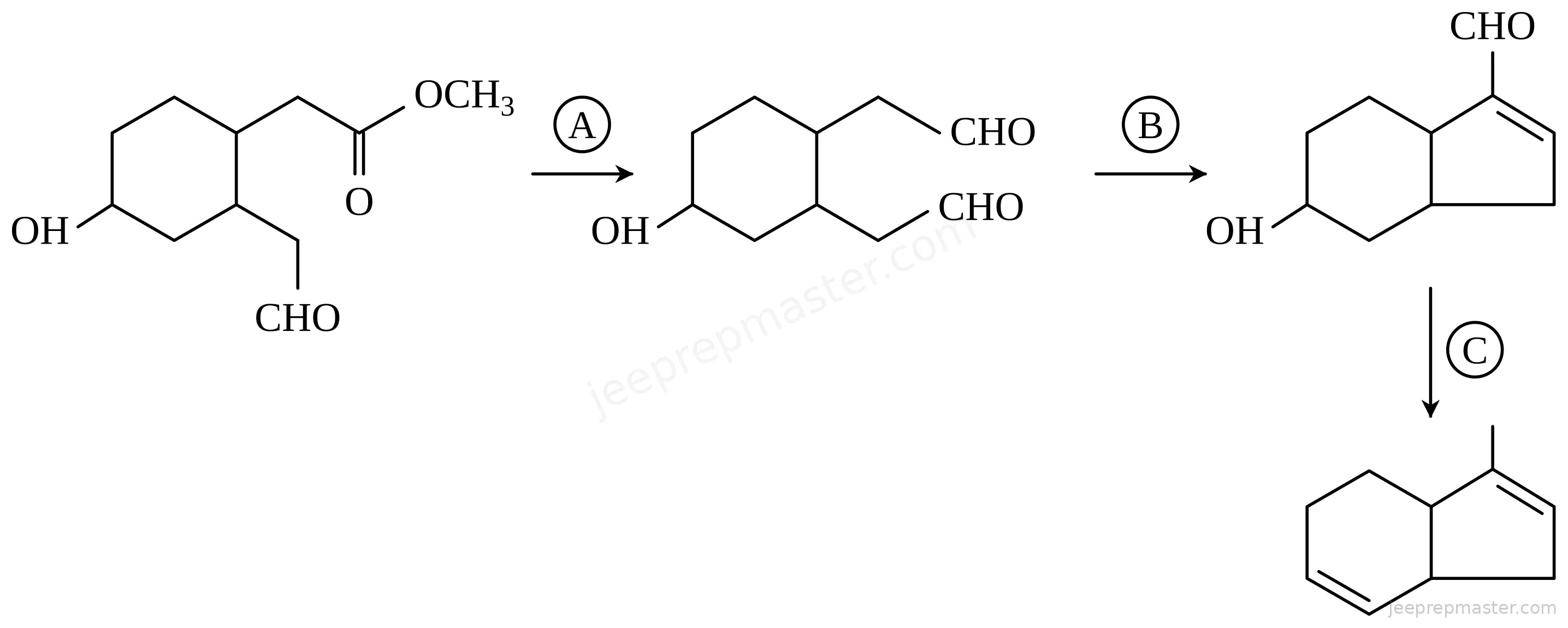
Identify the reagents used for the following conversion
Show answer and solution
Correct answer: Option 4
The first depicted change is partial reduction of an ester, , to an aldehyde, . The reagent for this partial reduction is DIBAL–H under controlled partial-reduction conditions; would reduce an ester to a primary alcohol.
Taking that dialdehyde intermediate as shown, base promotes an intramolecular aldol reaction. Enolate attack joins the two side chains, producing a five-membered ring; dehydration then gives the conjugated cyclic aldehyde. Alcoholic NaOH is the listed reagent for this condensation.
The last product has two changes: its formyl group has become a methyl group, and the original ring OH has been eliminated to give a second C=C bond. The Zn/HCl choice supplies acidic carbonyl-reduction conditions and allows the depicted acid-catalysed dehydration. The basic Wolff–Kishner conditions would not normally dehydrate that alcohol.
Thus, for the sequence as depicted, the reagents are DIBAL–H, alcoholic NaOH, then Zn/HCl: option (4).