
JEE Main 23 January 2026 Shift 2: Chemistry Question 58
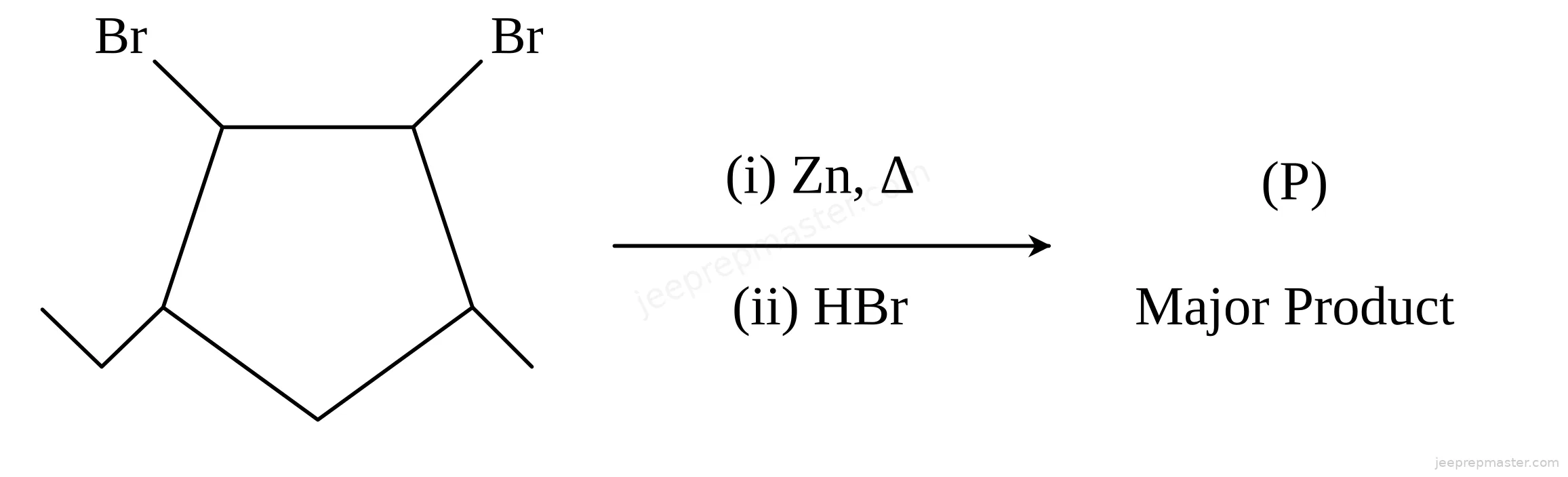
Identify
Show answer and solution
Correct answer: Option 1
heat removes the two bromine atoms from the adjacent ring carbons as , creating a bond between those two carbons. The intermediate is the cyclopentene whose two neighbouring saturated ring carbons carry ethyl and methyl substituents.
Addition of proceeds through protonation of that double bond. Either protonation direction initially gives a secondary carbocation. A hydride shift from the adjacent alkyl-substituted ring carbon then moves the positive charge to a tertiary carbon; this rearrangement is more favourable than retaining the secondary centre.
There are two relevant rearranged tertiary cations: one on the methyl-bearing carbon and one on the ethyl-bearing carbon. In the usual exam – hyperconjugation count, the methyl-bearing cation has seven adjacent hydrogens: two on each neighbouring ring group and three on . The ethyl-bearing alternative has six: two on each neighbouring ring and two on the attached ethyl .
Within that counting model, the methyl-bearing tertiary cation is favoured. Capture by places on the same ring carbon as the methyl substituent. This is the structure in option .