
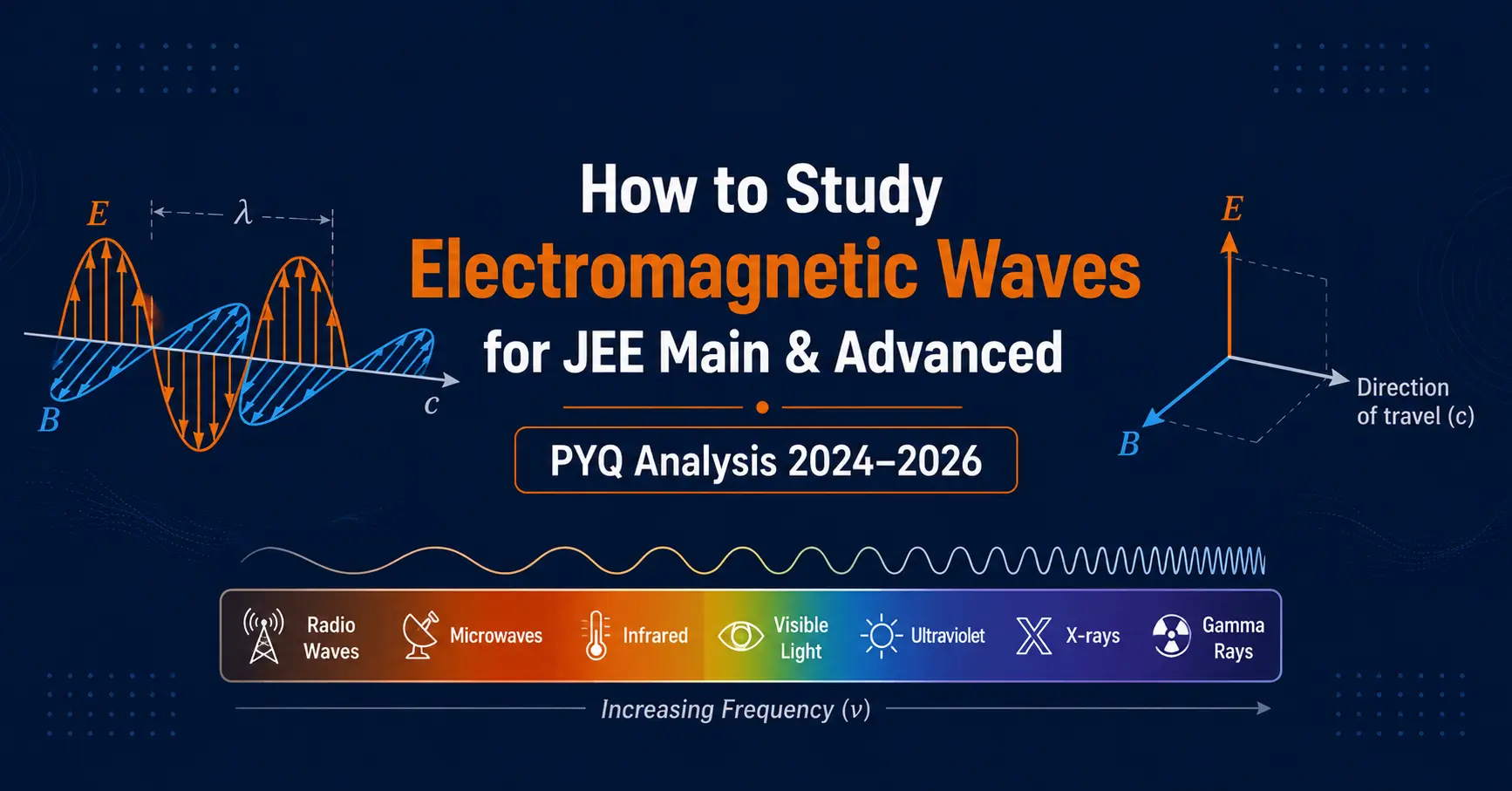
How to Study Electromagnetic Waves for JEE Main & Advanced | PYQ Analysis 2024–2026

JEE Preparation · Physics · PYQ Analysis
How to Study Electromagnetic Waves for JEE Main & Advanced: Complete PYQ Analysis 2024–2026
By JEE Prep Master · Updated July 2026 · 18 minute read
Electromagnetic Waves (EM Waves) is the shortest chapter in the Electricity & Magnetism block, but it has quietly become one of the most reliable scoring chapters in JEE Main Physics. With 15 questions in JEE Main 2024, 10 in JEE Main 2025, and 17 in JEE Main 2026 (a +69.67% weightage jump), this compact chapter now rewards focused preparation more than almost any other topic per hour invested. If you’re working out how to study Electromagnetic Waves for JEE efficiently, this guide shows you exactly which few formulas and question types you actually need.
This is a data-driven, PYQ-backed strategy built from every EM Waves question in JEE Main 2024, 2025, and 2026 (January + April sessions, all shifts) along with JEE Advanced from 2020 through 2026. We’ve broken the chapter into six sub-topics — E-B Field Relations, Wave Propagation Properties, Intensity/Power/Radiation Pressure, Displacement Current, EM Spectrum & Maxwell’s Equations, and Conceptual/Assertion-Reason — and mapped exactly where this small chapter’s marks concentrate.
If you want personalised guidance on how EM Waves fits into your overall Electricity & Magnetism revision, check out our JEE Counselling 2026 service, or attempt our full-length test series to benchmark your EM Waves preparation right now.
Electromagnetic Waves JEE PYQ Analysis 2024–2026: Year-Wise Question Count
Before breaking down sub-topics, here’s the year-by-year count — and the 2026 jump is the single most important data point in this article:
| Year | JEE Main Questions | JEE Advanced Questions | Remarks |
|---|---|---|---|
| 2024 | 15 | 0 | E-B relation and wave propagation questions dominate |
| 2025 | 10 | 1 | Lightest Main year; core E-B and intensity concepts only |
| 2026 | 17 | 1 | Sharp +69.67% weightage recovery; vector-form E-B questions surge |
JEE Advanced year-wise (2020–2026): 2020: 0 · 2021: 0 · 2022: 0 · 2023: 1 · 2024: 0 · 2025: 1 · 2026: 1 — a total of just 3 questions across 7 years, confirming EM Waves is the lowest-frequency chapter of the entire Electricity & Magnetism block at the Advanced level.
Sub-Topic Wise Frequency Table: Where Do the Marks Actually Come From?
| Sub-Topic | 2024 | 2025 | 2026 | Total (3 yrs) | Trend |
|---|---|---|---|---|---|
| E-B Field Relation (given E find B or vice versa, direction) | 6 | 3 | 7 | 16 | ↑↑ Rising, dominant sub-topic |
| Wave Propagation Properties (refractive index, speed in medium) | 3 | 2 | 3 | 8 | → Stable |
| Intensity / Average Power / Radiation Pressure | 3 | 2 | 3 | 8 | → Stable |
| Displacement Current (Maxwell-Ampere law, capacitor) | 2 | 1 | 2 | 5 | → Stable |
| EM Spectrum & Maxwell’s Equations (List matching) | 1 | 1 | 2 | 4 | ↑ Rising |
| Conceptual / Assertion-Reason (energy, momentum, pressure) | 0 | 1 | 0 | 1 | → Rare |
5 New Patterns Identified in JEE Main 2026 Electromagnetic Waves
Our analysis of the 17 EM Waves questions across JEE Main 2026 sessions reveals five shifts worth internalising, especially given this is the year the chapter’s weightage jumped sharply:
- Vector-form E-B questions with explicit unit vectors have surged. Multiple 2026 questions (4th April Evening, 2nd April Evening, 21st January Morning) give E or B as a full vector with î, ĵ, k̂ components and a specific propagation direction, requiring you to apply the right-hand rule (or E×B ∝ direction of propagation) rather than just the scalar relation E₀ = cB₀.
- E-B wave problems combined with charged-particle force comparisons. The 2nd April Morning 2026 question gives an EM wave’s E-field equation and an electron moving in the y-direction at a specified speed, then asks for the ratio of maximum electric to magnetic forces on the electron — a genuine hybrid of EM wave properties and the Lorentz force.
- Intensity questions built around spherical geometry traps. The 6th April Morning 2026 question places a detector on the same spherical surface as the original measurement point, shifted by 45°, and asks for the new intensity — testing whether students realise intensity from a point source depends only on distance (constant on a sphere), not angular position, making the “45°” detail a distractor.
- Displacement current questions appearing more than once per session. Both the 21st January Evening and 5th April Morning 2026 sessions tested displacement current — once via conduction-to-displacement current density ratio in a conducting medium, and once via the standard capacitor dV/dt setup — confirming this sub-topic’s growing consistency.
- Refractive index derived from wave-equation exponents directly. Rather than stating the refractive index or dielectric constant outright, 2026 questions (22nd January Morning, 28th January Morning, 23rd January Evening) require you to extract the wave speed from the coefficients of x and t in the given E(x,t) expression, then compare to c to find n — a deeper wave-equation manipulation than earlier years.
How to Study Electromagnetic Waves for JEE: Mastering Each Sub-Topic
Sub-Topic 1: E-B Field Relation (Highest Priority)
This is the single most tested sub-topic in EM Waves with 16 questions across 3 years — more than a third of the entire chapter’s marks.
- Magnitude relation: E₀ = cB₀ (always true in free space, where c = 1/√(μ₀ε₀))
- Direction relation: E, B, and the direction of propagation are mutually perpendicular, related by E×B pointing along the propagation direction (right-hand rule)
- Given E(x,t) = E₀sin(kx−ωt)ĵ propagating along +x: B must be along ẑ (or −ẑ, checked via the right-hand rule) with B(x,t) = (E₀/c)sin(kx−ωt)k̂
- In a medium (non-vacuum): replace c with v = c/n, or use v = 1/√(μdivision ε) with the medium’s actual permittivity and permeability
Must-solve 2026 questions: B = B₀sin(2πνt − 2πx/λ)ĵ — find associated E (4th April Evening); B = 2×10⁻⁷ĵ T at a point in free space — find E (2nd April Evening); E = 69sin[0.6×10³x − 1.8×10¹¹t] — find expression for B (21st January Morning); Ey = 300sinω(t−x/c) with an electron restricted to y-direction motion — ratio of max electric to magnetic forces (2nd April Morning).
Sub-Topic 2: Wave Propagation Properties
A stable sub-topic (2-3 questions per year) testing how wave speed, wavelength, and refractive index relate to the medium’s properties.
- Speed of EM wave in a medium: v = c/√(μᵣεᵣ), where μᵣ and εᵣ are relative permeability and permittivity
- Refractive index: n = c/v = √(μᵣεᵣ) (for a non-magnetic medium, μᵣ ≈ 1, so n = √εᵣ = √k, the dielectric constant)
- Extracting speed from the wave equation: for E(x,t) = E₀sin(ax − bt), the wave speed is v = b/a (ratio of the time-coefficient to the space-coefficient); compare this v to c to find n
Must-solve 2026 questions: Ey = 20sin(3×10⁶x − 4.5×10¹⁴t) — find the dielectric constant (22nd January Morning); E(x,t) = 25sin(2.0×10¹⁵t − 10⁷x)n̂ — find the refractive index (28th January Morning); ratio of speeds in vacuum vs. a medium with k=3, μ=2μ₀ (23rd January Evening).
Struggling with Electromagnetic Waves?
Our student Ishaan Singh scored AIR 2046 in JEE Advanced after 1-on-1 Physics coaching with our faculty.
Book a session — cover complete theory, PYQs and exam techniques at your own pace.
🎁 Free 30-min mentorship · 🛡 100% refund guarantee if not satisfied · 💬 7-day WhatsApp access
Sub-Topic 3: Intensity, Average Power, and Radiation Pressure
A stable sub-topic (2-3 questions per year) that rewards knowing a small set of interlinked formulas cold.
- Average intensity: I = ½ε₀cE₀² = ½(E₀B₀/μ₀) — both forms should be equally familiar
- Amplitude of B from intensity: rearrange I = ½ε₀cE₀² and E₀ = cB₀ to solve for B₀ directly in terms of I
- Radiation pressure: for a perfectly absorbing surface, P = I/c; for a perfectly reflecting surface, P = 2I/c
- Intensity from a point source: I = P/(4πr²) — depends only on distance r, not on angular position on the surrounding sphere
Must-solve 2026 questions: E = √377 sin(6.27×10³t − 2.09×10⁻⁵x) — average power (23rd January Morning); point source, detector shifted 45° on the same spherical surface — find new intensity (6th April Morning); laser beam intensity 4.0×10¹⁴ W/m² — amplitude of B field (22nd January Evening).
Sub-Topic 4: Displacement Current
Displacement current has held a steady 1-2 questions per year and bridges electrostatics (capacitors) with the Ampere-Maxwell law.
- Displacement current: I_d = ε₀(dΦ_E/dt), where Φ_E is the electric flux through the surface
- In a charging/discharging capacitor: I_d equals the conduction current I in the wires (this equality is what makes Ampere’s law consistent even inside the capacitor gap where no conduction current flows)
- From dV/dt: I_d = C(dV/dt) for a parallel plate capacitor — directly usable when the rate of change of potential difference is given or asked for
- Ratio of conduction to displacement current density: in a lossy medium, J_c/J_d = σ/(ωε₀) — depends on conductivity and frequency
Must-solve questions: EM wave frequency 100 MHz in a medium of conductivity σ=10 mho/m — ratio of max conduction to displacement current density (21st January Evening 2026); capacitor 2.5μF, displacement current 0.25 mA — rate of change of potential difference (23rd January Evening 2025); displacement current of 4.0A in a 6μF capacitor — rate of change of potential difference (5th April Morning 2026).
Sub-Topic 5: EM Spectrum and Maxwell’s Equations (List Matching)
A smaller but rising sub-topic (1-2 questions per year, trending up) that tests recognition and classification rather than calculation.
- EM spectrum ascending/descending order: gamma rays < X-rays < ultraviolet < visible < infrared < microwaves < radio waves (by increasing wavelength)
- Production mechanisms: radio waves (oscillating circuits/antennas), microwaves (magnetron valves/klystrons), infrared (molecular vibrations), visible/UV (electronic transitions in atoms), X-rays (inner-shell electron transitions or bremsstrahlung), gamma rays (nuclear transitions)
- Maxwell’s four equations (integral form): Gauss’s law for electricity (∮E·dA = Q/ε₀), Gauss’s law for magnetism (∮B·dA = 0), Faraday’s law (∮E·dl = −dΦ_B/dt), Ampere-Maxwell law (∮B·dl = μ₀I_c + μ₀ε₀ dΦ_E/dt)
Must-solve 2026 questions: match EM wave types (radio, micro, infrared) with their production mechanism (24th January Morning); match relation with law, including Ampere’s circuital law (23rd January Morning).
JEE Advanced 2020–2026 Electromagnetic Waves: What Changed?
JEE Advanced tests EM Waves less than almost any other chapter — just 3 questions across all of 2020-2026, appearing in only 3 of those 7 years (2023, 2025, 2026). When it does appear, expect vector-heavy E-B problems in non-standard directions or dimensional-analysis reasoning.
2026 Paper 1 (vector-form E field, multiple statements): E = E₀sin(3y + 4z + ωt)î — students must determine the correct statements about this wave, likely including its direction of propagation (perpendicular to both the 3y and 4z coefficients’ combined direction) and the corresponding B field — testing full 3D vector reasoning rather than the simpler 1D x-propagation case common in Mains.
2023 Paper 2 (dielectric medium, 2D field): E = 30(2x̂ + ŷ)sin[2π(5×10¹⁴t − (10⁷/3)z)] Vm⁻¹ propagating in a dielectric medium — this combines a two-component E field with propagation in a medium (not free space), requiring the refractive-index-adjusted wave speed rather than c directly.
2025 Paper 1 (photon energy density to field amplitude): A cube of unit volume containing a given number of photons of known frequency — students must convert total photon energy to an equivalent EM wave energy density, then find the B field amplitude, bridging quantum (photon count) and classical (wave energy density) descriptions of light.
Recommended Study Sequence for Electromagnetic Waves
Given this is JEE Main’s smallest E&M chapter by content but currently its fastest-rising one, a focused 2-week sequence is enough to cover it thoroughly.
Week 1 — E-B Relation and Wave Propagation: Derive E₀ = cB₀ and the right-hand-rule direction relationship from Maxwell’s equations conceptually (you don’t need the full derivation, just the result and why the triad is right-handed). Practice converting between E and B for waves propagating along +x, −x, and non-axis directions using explicit unit vectors. Then cover wave speed in a medium, refractive index, and extracting wave speed directly from a given wave equation’s coefficients. Solve 15 PYQs mixing both sub-topics before moving on.
Week 2 — Intensity, Displacement Current, EM Spectrum, and Mixed Practice: Master the intensity formulas (I = ½ε₀cE₀², radiation pressure for absorbing vs. reflecting surfaces) and the point-source inverse-square-law trap. Cover displacement current as “electrostatics in disguise” — practice both the dV/dt form and the conduction-vs-displacement current density ratio form. Spend one day on EM spectrum ordering and production mechanisms, and one day on Maxwell’s four equations in integral form. Close with a timed, mixed 15-question set drawn from all three years, and attempt the 2-3 available JEE Advanced-style vector E-B problems even if targeting only Mains, since they sharpen your directional reasoning.
Resource Recommendation
For concept building: NCERT’s Electromagnetic Waves chapter is unusually sufficient on its own for JEE Main level — this is one of the few chapters where NCERT alone, read carefully, covers most of what’s tested. For problem-solving depth: HC Verma’s brief EM Waves section and DC Pandey’s worked examples on E-B vector problems. For JEE Advanced level: practice constructing the propagation direction from a 2D or 3D field expression, since that is the recurring Advanced-specific skill.
The Underrated Sub-Topic: Conceptual Assertion-Reason on Energy, Momentum, and Pressure
Conceptual Assertion-Reason questions on EM wave properties appear rarely (just 1 in our 3-year dataset) but are pure recall when they do — no calculation required at all.
Key facts to hold in memory: EM waves carry both energy and momentum, despite photons having zero rest mass (momentum p = E/c still applies). EM waves exert real, measurable pressure on surfaces they strike (radiation pressure), and this has been experimentally verified — it is not a purely theoretical prediction. The statement “EM waves carry energy but not momentum” is a commonly-tested false assertion, since momentum transfer is exactly what produces radiation pressure.
Common Mistakes in Electromagnetic Waves (And How to Avoid Them)
- Getting the B-field direction wrong from a given E-field direction. Always confirm E × B points along the propagation direction using the right-hand rule — don’t just guess based on “the other axis.”
- Treating intensity as angle-dependent from a point source. Intensity from an isotropic source depends only on distance, not angular position on a surrounding sphere — the 2026 “detector shifted by 45°” question specifically tests this.
- Forgetting to adjust wave speed for a medium. E₀ = cB₀ applies in free space; in a medium, use v = c/n in place of c, where n = √(μᵣεᵣ).
- Confusing radiation pressure for absorbing vs. reflecting surfaces. Absorbing surface: P = I/c. Perfectly reflecting surface: P = 2I/c (double, because momentum reverses rather than being absorbed).
- Misreading non-standard wave equation forms. When given sin(ax − bt) instead of sin(kx − ωt), correctly identify a as the wave number and b as the angular frequency before computing wave speed v = b/a.
- Treating displacement current as a separate physical current. Displacement current is a mathematical term that makes Ampere’s law consistent — it doesn’t represent moving charge, but it does produce a magnetic field exactly like conduction current would.
- Assuming “carries energy” implies “carries no momentum.” Both are true simultaneously for EM waves — energy and momentum are carried together, related by p = E/c, and this relationship underlies radiation pressure.
Is Electromagnetic Waves Difficult for JEE?
EM Waves is one of the more approachable chapters in JEE Main Physics once the E-B relation and its direction rule are internalised, since the total pool of distinct question types is genuinely small. The main difficulty comes from vector-form questions with non-axis propagation directions and from wave equations given in non-standard notation.
The realistic difficulty distribution: E-B relation (axis-aligned) — Easy. E-B relation (vector/non-axis direction) — Medium. Wave propagation/refractive index — Easy-Medium. Intensity/radiation pressure — Easy. Point-source geometry traps — Medium (conceptual, not computational). Displacement current — Easy-Medium. EM spectrum/Maxwell’s equations matching — Easy. Conceptual assertion-reason — Easy.
Can You Skip Electromagnetic Waves for JEE?
No — and this is one of the clearest “don’t skip” chapters in this entire blog series given the marks-per-hour-invested ratio. Even in its lightest year (2025), EM Waves contributed 10 questions, and the chapter’s small, well-defined set of sub-topics means full mastery is achievable in roughly two weeks. Skipping this chapter sacrifices some of the easiest marks available in JEE Main Physics.
Is Electromagnetic Waves Important Only for JEE Main or Also for Advanced?
Overwhelmingly a JEE Main chapter. With just 3 questions across all of 2020-2026 in JEE Advanced (appearing in only 3 of those 7 years), this is the lowest-priority chapter for Advanced-specific preparation in the entire E&M block. When it is tested at Advanced level, expect vector E-B problems in non-standard directions or dimensional-analysis reasoning connecting E, B, ε₀, and μ₀.
If you’re targeting IITs, treat EM Waves primarily as a high-value Mains chapter — the return on investment for Advanced-specific EM Waves prep is low simply because the chapter appears so rarely. Our Chapter Teaching service covers EM Waves efficiently for both exams, with a 100% refund guarantee if you’re not satisfied.
Electromagnetic Waves 80/20 Rule: What to Study for Maximum Marks
Frequently Asked Questions
How many questions come from Electromagnetic Waves in JEE Main 2026?
JEE Main 2026 had approximately 17 questions from Electromagnetic Waves across all sessions (January + April combined) — a +69.67% weightage jump from 2025, and the highest count in the three years we analysed.
Is Electromagnetic Waves easy or tough for JEE Main?
Mostly easy to medium. The chapter has a genuinely small set of distinct question types, and once the E-B relation, direction rule, and intensity formulas are internalised, most questions become fast to solve. Vector-form questions with non-axis propagation directions add moderate difficulty. With focused preparation, EM Waves can reliably yield 6-8 marks per JEE Main paper for relatively little study time compared to larger chapters.
Is Electromagnetic Waves important for JEE Main 2027?
Yes, and increasingly so — the +69.67% weightage jump in 2026 suggests NTA is testing this chapter more heavily than in recent years. E-B relation, wave propagation, and intensity remain the safest bets for 2027, with vector-form E-B questions likely to continue given their 2026 surge.
Can I skip Electromagnetic Waves for JEE Advanced?
It’s reasonable to deprioritise Advanced-specific EM Waves prep given just 3 questions across 2020-2026, appearing in only 3 of those 7 years. Focus Advanced study time on higher-frequency chapters first, but don’t skip EM Waves for Mains, where it’s one of the highest marks-per-hour-invested chapters available.
What is the easiest sub-topic in Electromagnetic Waves for quick marks?
EM spectrum ordering/production mechanisms and Maxwell’s equations matching are the easiest quick marks — both are pure recall with no calculation. Conceptual assertion-reason questions on energy/momentum are similarly fast once the key facts are memorised.
What is the toughest sub-topic in EM Waves exclusively for JEE Advanced?
Vector E-B problems with propagation in non-axis-aligned directions (e.g., a field varying with both y and z simultaneously) are the hardest EM Waves problems exclusive to JEE Advanced, since they require full 3D vector reasoning rather than the simpler 1D axis-aligned case tested almost exclusively in Mains.
Conclusion: Your Action Plan for Electromagnetic Waves
Electromagnetic Waves is proof that a small chapter can still be a high-value one. If you’re mapping out how to study Electromagnetic Waves for JEE, the good news is that the chapter’s entire content fits into roughly six sub-topics, and E-B Field Relation alone covers 38% of the marks. With the +69.67% weightage jump in 2026, this chapter deserves more attention in your 2027 preparation than its small syllabus footprint might suggest.
Prioritise E-B relation and wave propagation first, layer in intensity and displacement current next, and treat EM spectrum classification and conceptual questions as fast, low-effort marks to pick up in your final revision pass. Given how compact this chapter is, full mastery is realistically achievable in two focused weeks.
If you’re preparing for JEE 2027 and want a structured roadmap covering Electromagnetic Waves and every other chapter with actual IITian faculty guidance, explore our JEE test series for EM Waves chapter tests, or book a doubt session to target your specific weak areas. For personalised JoSAA and college-selection strategy, our JEE Counselling 2026 service is available through all six rounds.
Small chapter, real marks, clear plan. Execute it and move to your next priority topic with one more chapter fully secured.
Related Chapter Guides
EM Waves closes out the Electricity & Magnetism block — read alongside these other chapter guides for a complete revision plan: How to Study Magnetism for JEE · How to Study Capacitors for JEE · How to Study Electromagnetic Induction for JEE · How to Study Alternating Current for JEE
AIR 2046 student result · Free mentorship · 100% refund guarantee