
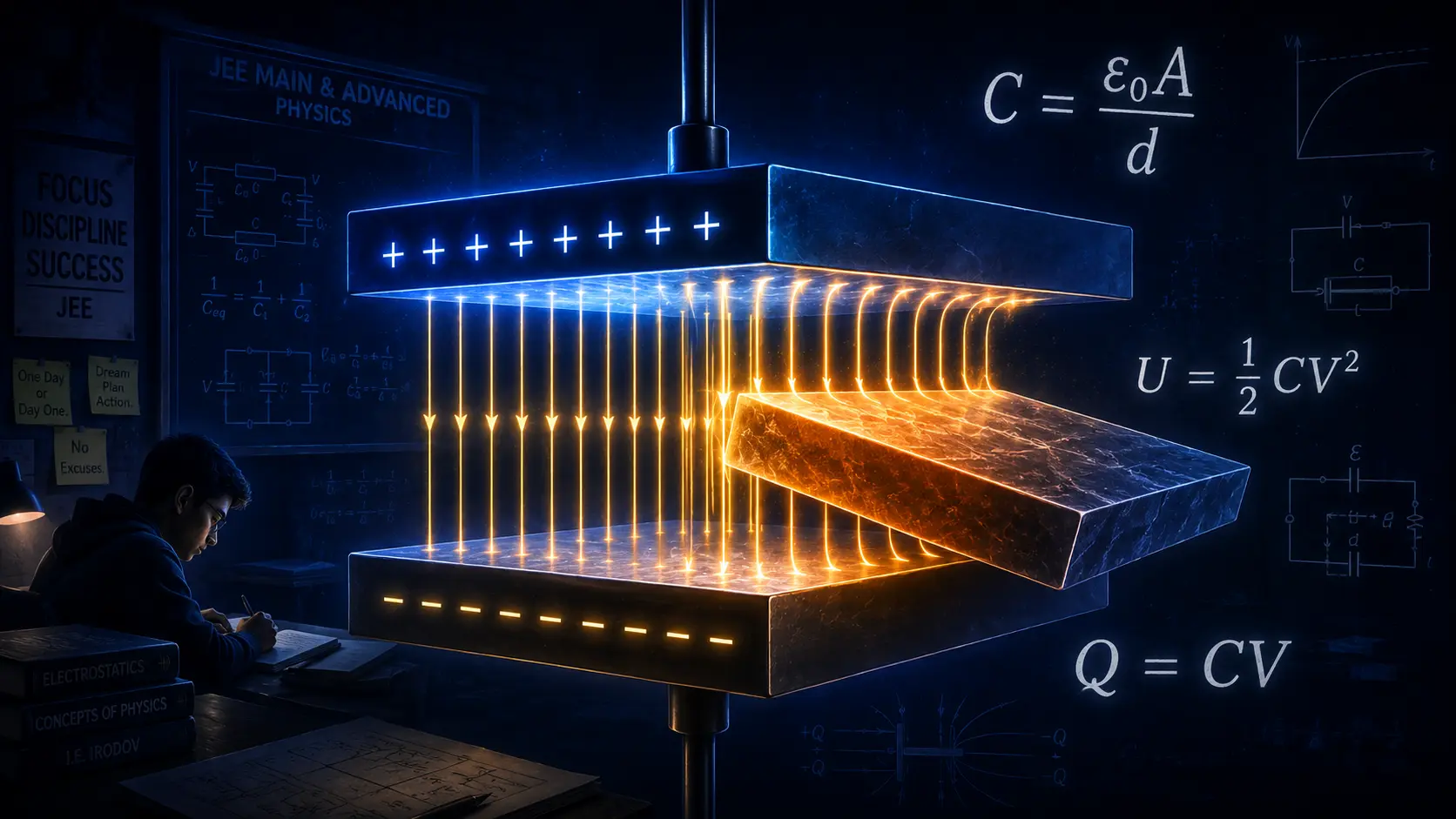
How to Study Capacitors for JEE Main & Advanced | PYQ Analysis 2024–2026

How to Study Capacitors for JEE Main and Advanced: Complete PYQ Analysis 2024–2026
If you want to know how to study capacitors for JEE, you need more than a textbook — you need to know exactly what JEE actually asks, how the pattern has shifted from 2024 to 2026, and which sub-topics are non-negotiable. Capacitors is one of the most consistent chapters in JEE Main, appearing with 13–16 questions across sessions every single year. In this guide, we break down every sub-topic with real PYQ patterns, year-wise frequency data, and specific strategy from our faculty — so you spend your time on what matters. This blog is part of our JEE Physics PYQ Analysis series. Whether you’re searching for exactly how to study capacitors for JEE or looking for a complete PYQ breakdown, Whether you’re targeting JEE Main 2027 or JEE Advanced 2027, this chapter-level breakdown will tell you exactly where to focus.Section 1: Why Capacitors Is a High-Priority Chapter for JEE
Capacitors consistently delivers 2–4 questions in every JEE Main session. Across all sessions in 2024, 2025, and 2026, this chapter has never missed a single paper. That level of consistency is rare in JEE Physics — only Current Electricity and Electrostatics match it. More importantly, Capacitors connects to multiple other chapters. Energy stored in a capacitor ties back to Work and Energy. RC circuits require Current Electricity concepts. Dielectric behaviour connects to Electrostatics. Students who master Capacitors properly find that these connections start paying dividends across the paper. For JEE Advanced aspirants, this chapter is even more critical. JEE Advanced has historically tested deep conceptual problems on RC circuits, charge redistribution with multiple switches, and dielectric insertion with battery connected or disconnected — problems that require you to think through four or five steps before writing a single equation.“Capacitors is a chapter where I see students lose marks they should never lose. The steady-state problem, the charge redistribution problem, the energy loss on connection — these are predictable patterns. If a student cannot solve these three types reliably, they haven’t studied this chapter. The concepts are not difficult; the gaps are always in systematic approach.” — MS Salim Sir, Physics Faculty (Ex-HOD Allen Kota, IIT BHU alumni, Super 30)The data backs this up. In JEE Main 2026 alone, 4 out of the 13 visible Capacitors questions involved dielectrics in some form — either finding the dielectric constant, calculating percentage increase in capacitance, or understanding what happens when a dielectric is inserted with or without the battery connected. That is a 31% share of the chapter going to one sub-topic.
1-on-1 Chapter Coaching
Struggling with Capacitors?
Our student Ishaan Singh scored AIR 2046 in JEE Advanced after 1-on-1 Physics coaching with our faculty.
Book a session — cover complete theory, PYQs and exam techniques at your own pace.
Quick Overview
₹2,500
2 hrs
Mains Pack
₹5,899
6 hrs
Advanced Pack
₹9,999
10 hrs · HOD
✓ Free 30-min mentorship · ✓ 100% refund if not satisfied · ✓ 7-day WhatsApp access
Section 2: JEE Main Capacitors PYQ Analysis 2024, 2025, and 2026 — How to Study Capacitors for JEE
The following year-wise frequency table is built from actual PYQ data — JEE Main 2024 and 2025 from Vidyamandir Classes compiled PDFs, and JEE Main 2026 from ExamSIDE question database.Year-Wise Question Count by Sub-Topic
| Sub-Topic | JEE Main 2024 | JEE Main 2025 | JEE Main 2026 | Trend |
|---|---|---|---|---|
| Capacitor in circuits — steady state | 3 | 3 | 3 | → Stable (must-do) |
| Dielectric — K, induced charge, geometry | 2 | 4 | 4 | ↑ Rising sharply |
| Energy stored and energy loss on connection | 3 | 3 | 2 | → Stable |
| Charge redistribution / common potential | 2 | 2 | 1 | → Stable |
| Capacitance formula and geometry | 1 | 2 | 2 | ↑ Rising |
| Energy density between plates | 0 | 1 | 1 | ↑ New type, now regular |
| RC charging / discharging circuits | 1 | 1 | 0 | ↓ Lower frequency |
| Total | 13 | 16 | ~13 | — |
5 Key PYQ Patterns You Must Know
Pattern 1: Steady-state capacitor in a circuit appears in every single session. In steady state, no current flows through the capacitor branch. The voltage across the capacitor equals the voltage across the resistor in parallel with it. JEE 2024 had three such questions (Q1, Q2, Q8 in the Capacitors section). JEE 2025 had three again. JEE 2026 continued this — including a question asking for the potential difference across a capacitor in steady state (5th April Evening Shift 2026). If you cannot solve steady-state circuit problems in under 90 seconds, this is the first thing to fix. Pattern 2: Dielectrics are the fastest-growing sub-topic. From 2 questions in 2024 to 4 in 2025 and 4 again in 2026, dielectric problems have become the dominant question type in this chapter. The 2026 paper had multiple variants — a mica sheet drawing 25% more charge (23rd January Evening), a half-filled dielectric K=5 asking for percentage increase in capacitance (2nd April Morning), a sheet of thickness one-third of separation (21st January Morning), and a problem involving three capacitors with two different dielectric constants. JEE now tests dielectrics from three angles: effect on capacitance, effect on energy, and finding K from given data. Pattern 3: Energy density appeared in JEE Main 2025 and immediately became a regular type. The 2025 question (8th April Evening Shift) asked for energy density with C = 1 μF, V = 20 V, d = 1 μm — requiring students to compute the electric field first, then use u = ½ε₀E². JEE Main 2026 continued testing this type. Students who had not seen this type before 2025 typically lost this question. It is now a predictable, solvable type that takes under 2 minutes if practised. Pattern 4: Charge redistribution with common potential appears every year. JEE 2024 had two such problems. JEE 2025 had two again. JEE 2026 had at least one. The formula V_common = (C₁V₁ + C₂V₂)/(C₁ + C₂) must be reflexive. The follow-up calculation is always either the final charge on each capacitor or the energy lost in redistribution. Pattern 5: JEE 2026 introduced a new type — capacitor with plates being pulled apart while connected to battery. The 4th April Morning Shift question asked for the time rate of change of electrostatic energy as proportional to x^α where x is the separation. This involves differentiating the energy expression U = ε₀AV²/2x with respect to time, giving dU/dt ∝ -(1/x²)(dx/dt). Since dx/dt = v (constant), dU/dt ∝ x⁻². So α = −2. This is a calculus-based capacitor problem — a new twist that JEE 2027 and 2028 aspirants must be prepared for.“The dielectric question in JEE 2026 — the mica sheet drawing 25% more charge — is identical in structure to a 2024 question about a dielectric sheet of 2 mm in a 5 mm capacitor. JEE recycles this framework every 2–3 years. The numbers change; the method does not. Students who solved the 2024 version should have got the 2026 version in 90 seconds.” — MS Salim Sir
Section 3: JEE Advanced Capacitors PYQ Pattern — How to Study Capacitors for JEE Advanced
JEE Advanced tests Capacitors at a fundamentally different level. From ExamSIDE data across 2013–2024, the following question types appear exclusively or predominantly in JEE Advanced: Multi-switch RC problems — JEE Advanced 2013 (Paper 1) had a three-switch capacitor problem requiring you to track charge on capacitor C₂ through a sequence of switching operations. The logic is step-by-step: close S₁, find steady state; open S₁, close S₂; find new steady state; repeat. JEE Main never tests this type. Dielectric inserted in a circuit with changing geometry — JEE Advanced 2022 (Paper 1) tested a capacitor filled with dielectric K where both plates are moved simultaneously by d/2 from their original positions. This requires tracking both the new separation and the dielectric configuration — a level of problem that JEE Main never reaches. Partial dielectric coverage — JEE Advanced 2014 (Paper 1) had a dielectric slab covering 1/3 of the plate area. Calculating total capacitance (two capacitors in parallel — one with dielectric, one without) and then finding charge distribution and field in each region is a 4-step problem. JEE Main asks at most a 2-step version of this. RC circuits with time-dependent analysis — JEE Advanced 2023 (Paper 1) had an RC circuit where the key K is closed at t = t₀ with the capacitor initially uncharged. Students had to identify correct statements about current and voltage at t = t₀ and as t → ∞. IIT-JEE 2010 (Paper 2) asked at what time the voltage across the capacitor reaches 4V in a circuit with a 2 MΩ resistor and 2 μF capacitor — requiring solution of V(t) = V₀(1 − e^(−t/RC)). Liquid dielectric problems — JEE Advanced 2023 had a container being filled with liquid dielectric at a uniform rate of 250 cm³/s, asking for the capacitance after 10 seconds. This requires modelling the capacitor as two capacitors in parallel (liquid-filled and air-filled portions), with the liquid height changing with time.“For JEE Advanced, Capacitors is one of those chapters where the question looks like a paragraph. Students get intimidated and skip it. My advice: read the first two lines, draw the circuit or geometry, identify what changes at each step. The physics is never beyond Class 12 — what JEE Advanced tests is whether you can execute a 5-step problem without losing track.” — MS Salim Sir
Section 4: Complete Sub-Topic Breakdown with Difficulty and Weightage
The following covers every sub-topic you will encounter when you study capacitors for JEE Main and Advanced. Understanding each type is essential when you learn how to study capacitors for JEE effectively.4.1 Capacitance — Basic Formula and Geometry: How to Study Capacitors for JEE Step 1
The fundamental formula C = ε₀A/d applies to a parallel plate capacitor with vacuum between the plates. JEE tests this in three ways: computing C from given dimensions, computing how C changes when dimensions change (area doubled, separation halved, etc.), and comparing two capacitors with different geometries. In JEE Main 2025 (8th April Evening), a question gave C = 1 μF, V = 20 V, d = 1 μm and asked for energy density — which requires you to first compute E = V/d = 20 × 10⁶ V/m, then use u = ½ε₀E². The 2026 paper (4th April Evening) asked for the capacitance between terminals A and B in a circuit with C₁ = C₂ = C₃ = 1 μF and C₄ = 2 μF. JEE Advanced 2024 (Paper 1) had four identical thin square metal sheets S₁, S₂, S₃, S₄ each of side a kept parallel with equal distance d. This requires identifying which pairs of surfaces form capacitors and then combining them correctly — the kind of geometry analysis that separates JEE Main and Advanced preparation. Difficulty for JEE Main: Low to Medium. Expected time: 60–90 seconds.4.2 Capacitors in Series and Parallel
Series: 1/C_eq = 1/C₁ + 1/C₂ + … Parallel: C_eq = C₁ + C₂ + … JEE Main tests combination circuits that require reducing the network step by step. The 2026 question (4th April Evening, capacitance between A and B with four capacitors) requires identifying that C₃ is in parallel with the series combination of C₁ and C₂, then adding C₄. The trap in combination problems is identifying which capacitors are truly in series versus parallel. Two capacitors are in series only if they carry the same charge (no junction between them with another branch). Two are in parallel only if both terminals are at the same potential. Difficulty for JEE Main: Medium. Expected time: 90–120 seconds.4.3 Capacitor in a DC Circuit — Steady State (Most Tested Type)
This is the single most tested type in JEE Main Capacitors — appearing in every session without exception. In steady state, no current flows through the capacitor. The capacitor branch is effectively an open circuit. The circuit simplifies to the resistors only, and the voltage across the capacitor equals the voltage across whatever is in parallel with it. JEE Main 2024 (Q1, Capacitors section) had a 10 μF capacitor in a circuit with a 10V battery, a 4Ω resistor in series, a 5Ω resistor in the capacitor branch, and a 6Ω resistor. In steady state, no current through 5Ω. Current = 10/(6+4) = 1A. Voltage across 6Ω = 6V. Charge on capacitor = 10 × 6 = 60 μC. JEE Main 2025 (Q1, Capacitors section) had an 8 μF capacitor in a circuit with a 5V battery, 10Ω and 15Ω resistors. In steady state: I = 5/(10+15) = 1/5 A. Voltage across 10Ω = 10 × 1/5 = 2V. Q = 8 × 2 = 16 μC. JEE Main 2026 (5th April Evening) asked for the potential difference across the capacitor in steady state in a circuit with a 2Ω resistor in one branch and a 1Ω resistor — the method is identical. The pattern is completely fixed. Three-step solution every time: (1) open the capacitor branch, (2) find the current in the simplified circuit, (3) find the voltage across whatever is parallel to the capacitor.“Steady-state capacitor problems in JEE Main have a fixed algorithm. I tell students: if you see a capacitor in a DC circuit and no mention of time, it is a steady-state problem. Open the branch. Solve the resistor circuit. Find the parallel voltage. That is it. There is no variation that breaks this algorithm.” — MS Salim SirDifficulty for JEE Main: Low. Expected time: 60–90 seconds.
4.4 Energy Stored in a Capacitor
U = ½CV² = Q²/2C = QV/2. JEE tests this in three forms: direct calculation, comparison of energies before and after a change, and energy loss when two capacitors are connected. JEE Main 2024 (Q3, Capacitors) had two identical capacitors — one charged to V, one to 2V — negative ends connected, then positive ends connected. Initial energy U_i = ½CV² + ½C(2V)² = 5CV²/2. After connection, charge redistributes: q = 3CV/2. Final energy U_f = 9CV²/4. Energy loss = 5CV²/2 − 9CV²/4 = CV²/4. JEE Main 2025 (Q2, Capacitors) had a 40 μF capacitor connected to 100V, then dielectric K=2 inserted while battery stays connected. Initial charge Q₁ = 40 × 100 = 4000 μC = 4 mC. New capacitance = 80 μF. New charge = 8 mC. Extra charge = 4 mC. Change in energy: initial U = ½ × 40 × 10⁻⁶ × 100² = 0.2 J. Final U = ½ × 80 × 10⁻⁶ × 100² = 0.4 J. Increase = 0.2 J. Critical rule: When battery stays connected, voltage is constant — capacitance doubles, charge doubles, energy doubles. When battery is disconnected, charge is constant — capacitance doubles, voltage halves, energy halves. Difficulty for JEE Main: Medium. Expected time: 90–150 seconds.4.5 Energy Density Between Plates
u = ½ε₀E² (energy per unit volume between the plates). This type appeared for the first time in JEE Main 2025 and continued in 2026, making it a now-established question type. The steps: compute E = V/d, then u = ½ε₀E². With ε₀ = 8.85 × 10⁻¹² F/m, and E in V/m, the result is in J/m³. JEE Main 2025 (Q8, Capacitors): C = 1 μF, V = 20 V, d = 1 μm. E = 20/(10⁻⁶) = 20 × 10⁶ V/m. u = ½ × 8.85 × 10⁻¹² × (20 × 10⁶)² = ½ × 8.85 × 10⁻¹² × 4 × 10¹⁴ = 1.77 × 10³ J/m³ ≈ 1.8 × 10³ J/m³. Difficulty for JEE Main: Low (once the formula is known). Expected time: 60 seconds.4.6 Charge Redistribution and Common Potential
When two charged capacitors are connected in parallel: V_common = (C₁V₁ + C₂V₂)/(C₁ + C₂). The charges after equilibrium: q₁ = C₁V_common, q₂ = C₂V_common. Energy lost = ½ × (C₁C₂)/(C₁+C₂) × (V₁−V₂)². JEE Main 2025 (Q9, Capacitors): C₁ = 6 μF charged to V₀ = 5V, battery removed. C₂ = 12 μF uncharged inserted. Switch S closed. V_common = (6×5 + 0)/(6+12) = 30/18 = 5/3 V. q₁ = 6 × 5/3 = 10 μC. q₂ = 12 × 5/3 = 20 μC. JEE Main 2026 (6th April Evening): Two spheres of capacitance 100 pF each touching — charge redistribution problem. V_common = total charge / total capacitance = (100 × 100 + 0)/(200) = 50V. Energy before = ½ × 100 × 10⁻¹² × 100² = 5 × 10⁻⁷ J. Energy after = ½ × 200 × 10⁻¹² × 50² = 2.5 × 10⁻⁷ J. Change = −2.5 × 10⁻⁷ J = −25 × 10⁻⁸ J.“Charge redistribution is the most formula-dependent sub-topic in Capacitors. Students know the formula but make sign errors when capacitors are connected in opposition. I insist students always assign a direction to charge before writing the conservation equation. ‘Total charge is conserved’ — but you need to define what you mean by total. If both positive plates are connected, total charge = Q₁ + Q₂. If positive of one is connected to negative of other, total charge = Q₁ − Q₂.” — MS Salim SirDifficulty for JEE Main: Medium. Expected time: 90–120 seconds.
4.7 Dielectrics — The Dominant Sub-Topic of JEE Main 2025 and 2026
With 4 questions per year since 2025, dielectrics is now the highest-frequency sub-topic in this chapter. Anyone who wants to know how to study capacitors for JEE Main effectively must master this sub-topic first. The key formula: C = Kε₀A/d. The induced charge on dielectric surface: Q_ind = Q(1 − 1/K). The electric field inside dielectric: E_d = E₀/K where E₀ is the field without dielectric. JEE tests dielectrics in four specific scenarios: Scenario A — Dielectric inserted, battery connected: Voltage stays constant at V. New capacitance C’ = KC. New charge Q’ = KC V = KQ. Energy stored U’ = ½KC·V² = KU. The battery supplies extra charge Q(K−1) and the energy stored increases by factor K. Scenario B — Dielectric inserted, battery disconnected: Charge stays constant at Q. New capacitance C’ = KC. New voltage V’ = Q/KC = V/K. Energy U’ = Q²/2KC = U/K. Energy decreases — it goes into doing work in pulling the dielectric in. Scenario C — Finding K from charge data: JEE Main 2026 (23rd January Evening) — a 5 mm capacitor charged by battery. 2 mm mica sheet inserted, battery still connected. Capacitor draws 25% more charge. This means Q’ = 1.25 Q, so C’ = 1.25 C. C’ = ε₀A/(5−2+2/K) = ε₀A/(3 + 2/K). C = ε₀A/5. So 1/(3 + 2/K) = 1.25/5 = 1/4. 3 + 2/K = 4. 2/K = 1. K = 2. (Same structure as JEE 2024 Q4.) Scenario D — Geometry variants (half-filled, partial area, two dielectrics): JEE Main 2026 (2nd April Morning) had a parallel plate capacitor half-filled with K = 5 (as shown in figure). The two halves act as two capacitors in parallel. C_half_filled = ε₀(A/2)/d + Kε₀(A/2)/d = ε₀A(1+K)/2d. Percentage increase = [(1+K)/2 − 1] × 100 = (K−1)/2 × 100 = (5−1)/2 × 100 = 200%. JEE Main 2026 (24th January Evening) had three capacitors each with area A filled with two dielectrics k₁ and k₂ in three different configurations — a multi-correct or match-the-column type. Difficulty for JEE Main: Medium to High. Expected time: 120–180 seconds.4.8 RC Circuits — Charging and Discharging
Q(t) = CV(1 − e^(−t/RC)) for charging. Q(t) = Q₀e^(−t/RC) for discharging. Time constant τ = RC. At t = τ, charge reaches ~63% of maximum. At t = 5τ, essentially fully charged. JEE Main 2024 (Q12, Capacitors): Electric field drops to 1/3 in time t = 6.6 μs. Since E ∝ V ∝ Q, Q(t)/Q₀ = e^(−t/RC) = 1/3. So t/RC = ln 3. R = t/(C × ln 3) = 6.6 × 10⁻⁶ / (1.5 × 10⁻⁶ × 1.1) = 4 Ω. JEE Advanced tests RC circuits at a much deeper level — IIT-JEE 2010 (Paper 2) asked for the time at which voltage reaches 4V in a 2 MΩ – 2 μF circuit: V(t) = 10(1−e^(−t/RC)) = 4. So e^(−t/RC) = 0.6. t = RC × ln(5/3) = 4 × (ln5 − ln3) = 4 × (1.6 − 1.1) = 4 × 0.5 = 2 seconds. Difficulty for JEE Main: Medium. Expected time: 120 seconds. Difficulty for JEE Advanced: High.Section 5: Common Mistakes That Cost Marks
Based on pattern analysis across 2024–2026 PYQs, here are the specific mistakes JEE aspirants make in Capacitors problems. Understanding these will sharpen how you study capacitors for JEE: Mistake 1 — Not opening the capacitor branch in steady state. Students who don’t immediately recognise a steady-state problem try to use Kirchhoff’s laws with the capacitor branch included. This makes the problem unsolvable without differential equations. The rule is simple: DC circuit + capacitor + no mention of time = open the capacitor branch. Mistake 2 — Confusing battery connected vs. disconnected in dielectric problems. When battery is connected: V is constant. When battery is disconnected: Q is constant. Getting this wrong inverts the energy result completely. Always state this explicitly at the start of a dielectric problem. Mistake 3 — Sign error in charge redistribution when capacitors are in opposition. When the positive plate of capacitor 1 is connected to the negative plate of capacitor 2, the net charge is Q₁ − Q₂, not Q₁ + Q₂. This appears in JEE 2024 Q3 where negative ends were connected first, then positive ends — requiring you to track the charge sign carefully. Mistake 4 — Forgetting to account for partial dielectric in geometry problems. When a dielectric slab of thickness t < d is inserted in a gap d, the effective capacitance is C = ε₀A/(d − t + t/K). Students often write C = Kε₀A/d, which is only correct when the slab fills the entire gap. Mistake 5 — Using wrong formula for energy density. u = ½ε₀E² is in J/m³. u = ½CV²/Volume is equivalent but requires knowing the volume. Both give the same answer but students mix up units when the plate area and separation are given in inconsistent units (cm vs. m).“The dielectric partial-slab problem has a clean derivation: treat the gap as two capacitors in series — one with the dielectric of thickness t, one with air of thickness (d−t). The series combination gives 1/C = t/(Kε₀A) + (d−t)/(ε₀A). This is the formula students should derive once and remember as a concept, not memorise as a formula.” — MS Salim Sir
Section 6: Important Formulas Organised by Sub-Topic
The following is a complete formula reference for the JEE Capacitors chapter. These are not random formulas — each one has appeared in PYQs from 2024–2026. Basic capacitance: C = ε₀A/d (parallel plates, vacuum). C = 4πε₀R (isolated sphere of radius R). With dielectric: C = Kε₀A/d. Induced charge Q_ind = Q(1 − 1/K). E_inside = E₀/K. Partial dielectric (slab of thickness t, gap d): C = ε₀A/(d − t + t/K). Series combination: 1/C_eq = Σ(1/Cᵢ). Charge same on all. Voltage divides inversely proportional to capacitance. Parallel combination: C_eq = ΣCᵢ. Voltage same on all. Charge divides proportional to capacitance. Energy stored: U = ½CV² = Q²/2C = QV/2. Energy density: u = ½ε₀E² = U/(A×d). Units: J/m³. Charge redistribution: V_common = (C₁V₁ + C₂V₂)/(C₁ + C₂). Energy loss = ½ × [C₁C₂/(C₁+C₂)] × (V₁−V₂)². RC circuits: τ = RC. Charging: Q(t) = C_f(1−e^(−t/RC)). Discharging: Q(t) = Q₀e^(−t/RC). Force between plates: F = Q²/(2ε₀A) = ε₀AE²/2 = CV²/(2d).Section 7: How to Study Capacitors for JEE — Mastering Each Sub-Topic
Here is the exact sequence to study capacitors for JEE effectively, based on PYQ frequency and the typical preparation timeline of 4–6 weeks for this chapter. This is the most structured answer to the question of how to study capacitors for JEE Main and Advanced. Week 1 — Concept building (Days 1–4): Start with the derivation of C = ε₀A/d from first principles — understanding that capacitance is purely a geometric property. Then derive the series and parallel formulas from charge and voltage relationships. Build the energy derivation: work done charging a capacitor = ∫V dq = Q²/2C. On Day 4, do the dielectric derivation — why does inserting a dielectric increase capacitance? The answer lies in the induced dipoles reducing the internal electric field, which reduces the voltage for the same charge, which means more charge can be stored at the same external voltage. Week 1 — Concept building (Days 5–7): Steady-state capacitor circuits. Take 10 different steady-state circuit diagrams and solve them under time pressure. The goal is to make the “open branch” reflex automatic. Time yourself — these should take under 90 seconds each after 2 days of practice. Week 2 — PYQ drilling (Days 8–14): Now attack PYQs sub-topic by sub-topic. This is the core of how to study capacitors for JEE — active problem-solving, not passive reading. Start with steady state (3 questions guaranteed per session), then energy problems, then dielectrics. For dielectrics, specifically practice the “battery connected vs. disconnected” decision at the start of every problem. Solve all JEE Main 2024, 2025, and 2026 Capacitors questions. Count how many you solve correctly without hints. Target 80% before moving on.“For JEE Advanced preparation on Capacitors, I tell students to focus on three things: multi-switch problems, partial dielectric problems, and RC circuits with time. These are the three types that consistently separate ranks in the 1000–5000 range. None of these types requires anything beyond Class 12 physics — they just require systematic thinking. A student who has drilled 20 multi-switch problems will handle a JEE Advanced question in this chapter without panic.” — MS Salim SirWeek 3 — Error analysis and pattern matching: Go back to every question you got wrong. Categorise the error: Was it a concept gap (wrong formula), a method gap (wrong starting point), or a calculation error? Concept gaps need re-reading the derivation. Method gaps need more structured practice with the specific type. Calculation errors need speed drills. 80/20 rule for Capacitors: 80% of JEE Main marks in this chapter come from: (1) steady-state circuits, (2) energy stored and energy loss, (3) dielectric constant calculation. These three types cover 8–10 of the 13–16 questions that appear per year. If you are short on time, secure these three types first before attempting RC circuits or advanced geometry problems. For additional conceptual clarity and doubt resolution in this chapter, our Doubt Session Room with MS Salim Sir covers Capacitors in dedicated sessions — particularly the JEE Advanced level multi-step problems that are difficult to self-study. You can also explore our Chapter Teaching service for a complete structured walkthrough of this chapter from basics to JEE Advanced level, backed by our 100% refund guarantee. For JEE Main preparation as a whole, our JEE Test Series includes chapter-wise tests for Capacitors that mirror the actual session format. And if you are currently navigating JEE Main 2026 results and counselling, visit our JEE Counselling 2026 page — JoSAA 2026 Round 1 allotment is on June 13. For official NTA notifications related to JEE Main, refer to the JEE Main NTA official website.
Section 8: JEE Advanced Exclusive Topics in Capacitors
The following sub-topics have never appeared in JEE Main but are regularly tested in JEE Advanced. When you study capacitors for JEE Advanced, these types must be added to your list. If you are targeting JEE Advanced, add these to your preparation after securing the JEE Main-level types. Multi-switch sequential charging: A circuit with multiple switches S₁, S₂, S₃ that are opened and closed in sequence. At each step, find the new charge on every capacitor using conservation of charge and equal potential at connected nodes. JEE Advanced 2013 is the canonical example — three switches, two capacitors. Variable dielectric (liquid filling at a rate): JEE Advanced 2023 had a container being filled with liquid dielectric at 250 cm³/s. This requires modelling the capacitor as liquid-filled and air-filled portions in parallel, with the liquid height h(t) = Volume(t)/Area = 250t/2500 = 0.1t cm. The capacitance C(t) = ε₀×(50×50)/50 × [3h + (50−h)] = ε₀ × 50 × [1 + 2h/50]. At t = 10s, h = 1 cm. C = 9×10⁻¹² × 50 × (1 + 0.04) = a calculable value. Force on dielectric slab: When a dielectric is partially inserted between the plates of a capacitor connected to a battery, there is an attractive force pulling the dielectric in. F = ½(dC/dx)V² where x is the insertion depth. This type has appeared in JEE Advanced multiple times and requires differentiation of the capacitance expression with respect to the insertion variable. Capacitor with non-uniform dielectric (ε varies with position): If ε varies with the coordinate perpendicular to the plates, the capacitor can be modelled as infinitely many capacitors in series: 1/C = ∫dx/[ε(x)A]. This is a calculus-based extension that appears in JEE Advanced paragraph-type questions.Section 9: Revision Checklist — How to Study Capacitors for JEE in the Final 2 Weeks
Use this checklist in the last 2 weeks before your JEE attempt. It covers everything you need to know about how to study capacitors for JEE at the revision stage. Every item should be answerable in under 30 seconds. ☐ Can you write C = ε₀A/d and explain what each variable means physically? ☐ Can you derive the energy stored in a capacitor from first principles in 3 lines? ☐ Do you know the difference in outcome when a dielectric is inserted with battery connected vs. disconnected? ☐ Can you solve a steady-state capacitor circuit in under 90 seconds? ☐ Can you calculate energy density given C, V, and d? ☐ Do you know the formula for V_common in charge redistribution? ☐ Can you find the dielectric constant K from “capacitor draws X% more charge” data? ☐ Do you know the RC time constant formula and the charging/discharging equations? ☐ Can you handle the partial dielectric slab (thickness t in gap d) problem? ☐ [JEE Advanced only] Can you handle a multi-switch problem with step-by-step charge tracking?Conclusion
Capacitors is a chapter where consistent, structured practice pays off more than any other chapter in JEE Physics. The answer to how to study capacitors for JEE is simple: PYQ-first, pattern-first, algorithm-first. The PYQ data from 2024 to 2026 shows a remarkably predictable pattern — steady-state circuits every session, dielectrics in 4 questions per year, energy problems in 2–3 questions. If you know how to study capacitors for JEE systematically — securing the steady-state and energy types first, building dielectric intuition second, and adding RC circuits and JEE Advanced types last — you can reliably score in this chapter across every session. The new types introduced in 2025 and 2026 (energy density, calculus-based energy rate with moving plates) are not harder in concept — they just require you to have seen them before. This guide gives you that exposure. Now execute: take 20 PYQs from 2024–2026 and solve them against the clock. For any doubts in this chapter — especially the JEE Advanced level multi-step problems — our Doubt Session Room is available with MS Salim Sir. If you need end-to-end coverage of this chapter, visit our Chapter Teaching page.Frequently Asked Questions — Capacitors for JEE
How many questions come from Capacitors in JEE Main 2026?
Based on ExamSIDE data from JEE Main 2026 sessions (January and April), approximately 13 questions appeared across all sessions from the Capacitors chapter. This is consistent with 2024 (13 questions) and slightly lower than 2025 (16 questions). Dielectrics accounted for the largest share — 4 out of 13 questions — followed by steady-state capacitor circuits (3 questions) and energy stored/energy loss (2 questions).
Is Capacitors easy or difficult for JEE Main?
Capacitors is a medium-difficulty chapter for JEE Main. The most frequent question types — steady-state circuits and energy stored — are straightforward once you know the method. Dielectric problems (the most tested type since 2025) are slightly harder but follow predictable patterns. The chapter becomes significantly harder at JEE Advanced level, where multi-switch problems and variable dielectric questions require multi-step reasoning. For JEE Main, a student who has solved all 2024–2026 PYQs should be able to score 80–90% of marks available in this chapter.
Is Capacitors important for JEE Main 2027?
Yes, Capacitors is one of the most important chapters for JEE Main 2027. It has appeared in every single JEE Main session from 2024 to 2026 without exception, with 13–16 questions per year across all sessions. The chapter has a high predictability — steady-state circuits, dielectrics, and energy problems appear every year. Any JEE Main 2027 aspirant should treat this as a guaranteed-marks chapter and prepare it thoroughly.
Can you skip Capacitors for JEE?
Skipping Capacitors for JEE Main is a serious mistake. With 13–16 questions per year, this chapter alone contributes 4–5% of the total JEE Main question count. Additionally, Capacitors concepts connect to RC circuits (Current Electricity) and energy in electric fields (Electrostatics). Skipping Capacitors also weakens your performance in these connected chapters. For JEE Advanced, Capacitors is non-negotiable — it appears every year with multi-step problems that are high-scoring for well-prepared students.
What is the 80/20 rule for Capacitors in JEE Main?
The 80/20 rule for Capacitors in JEE Main: 80% of marks come from three sub-topics that account for roughly 8–10 questions per year. (1) Steady-state capacitor in DC circuit — 3 questions per year, straightforward algorithm, high ROI. (2) Energy stored and energy loss on connection — 2–3 questions per year, formula-based, medium difficulty. (3) Dielectric constant problems — 4 questions per year, now the highest-frequency sub-topic. Secure these three types before investing time in RC circuits or advanced geometry problems, which contribute fewer marks.
Which Capacitors topics are exclusive to JEE Advanced?
Several Capacitors topics appear exclusively or predominantly in JEE Advanced and rarely in JEE Main: (1) Multi-switch sequential charging problems — tracking charge through 3–4 switching operations. (2) RC circuits with time-dependent voltage analysis — finding time at which voltage/charge reaches a specific value. (3) Variable dielectric problems — liquid filling a capacitor at a given rate, requiring calculus-based integration. (4) Force on a dielectric slab during insertion — requires dC/dx calculation. (5) Non-uniform dielectric where permittivity varies with position. JEE Main tests only the first two in simplified form; the rest are JEE Advanced exclusive.