
JEE Main 7 April 2025 Shift 1: Chemistry Question 66
The reactions which cannot be applied to prepare an alkene by elimination, are
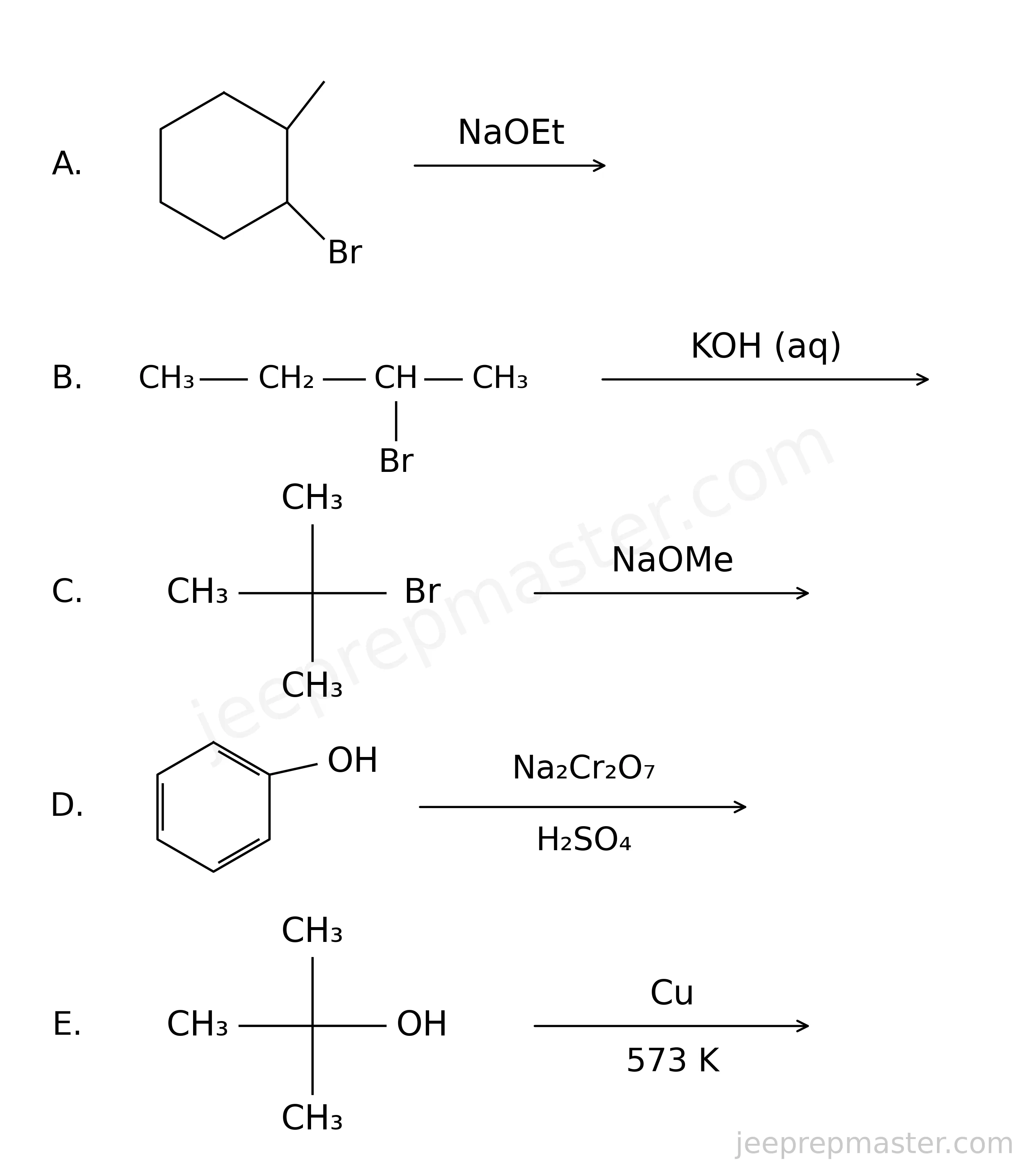
Choose the correct answer from the options given below :
Show answer and solution
Correct answer: Option 3
A uses sodium ethoxide on a secondary cyclohexyl bromide with available β-hydrogen atoms, allowing dehydrohalogenation. C is tert-butyl bromide with sodium methoxide; a tertiary halide cannot undergo ordinary displacement and readily eliminates to give 2-methylpropene. Thus A and C can prepare alkenes.
B uses aqueous KOH with 2-bromobutane. Under the standard school-level aqueous-versus-alcoholic reagent distinction, aqueous hydroxide is used for nucleophilic substitution to the alcohol rather than preparative dehydrohalogenation. D treats phenol with acidified dichromate, an oxidation condition, not an alkene-forming elimination route.
E is tert-butyl alcohol passed over heated copper at 573 K. A tertiary alcohol lacks the carbinol hydrogen required for dehydrogenation to a carbonyl compound and instead undergoes dehydration to 2-methylpropene under the stated textbook conditions. Therefore only B and D are unsuitable in the comparison, option (3).
“Cannot” in B is the textbook preparative distinction: aqueous KOH favours substitution, while alcoholic base is normally used for elimination. It is not a claim that an aqueous secondary-halide reaction can never have any competing elimination.