
JEE Main 4 April 2025 Shift 1: Chemistry Question 69
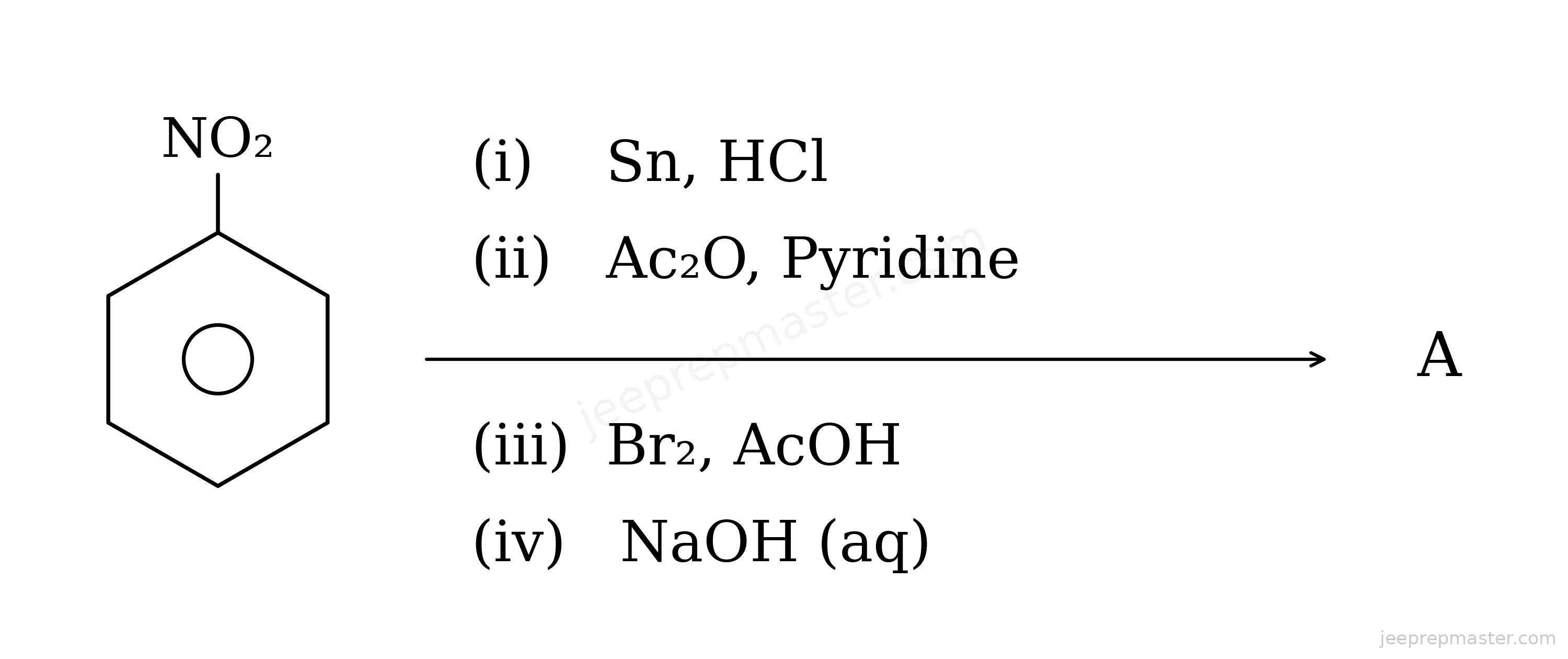
The major product A formed in the following reaction sequence is:
Nitrobenzene → (i) (ii) pyridine; (iii) (iv) → A
Show answer and solution
Correct answer: Option 4
reduces the nitro group of nitrobenzene to an amino group, giving aniline after the usual work-up. Acetic anhydride/pyridine then acetylates to form acetanilide, protecting the amino group as
The acetamido group is ortho/para directing but less strongly activating than free Controlled bromination with in acetic acid gives chiefly p-bromoacetanilide because para substitution is less sterically crowded than ortho substitution. Protection suppresses the extensive bromination characteristic of unprotected aniline.
The final aqueous NaOH step is the alkaline hydrolysis of the protecting acetamide, restoring while leaving the aryl C–Br bond intact. The product is p-bromoaniline, option (4), not the still-protected acetanilide.
The final step is interpreted as amide hydrolysis under the usual necessary reaction conditions; the abbreviated scheme does not explicitly print heating.