
JEE Prep Master

Reading mode

Text size

JEE Main 7 April 2025 Shift 2: Chemistry Question 75

HydrocarbonsNumerical answer+4 / −1

Identify structure of the final product (D) in the following sequence of the reactions:

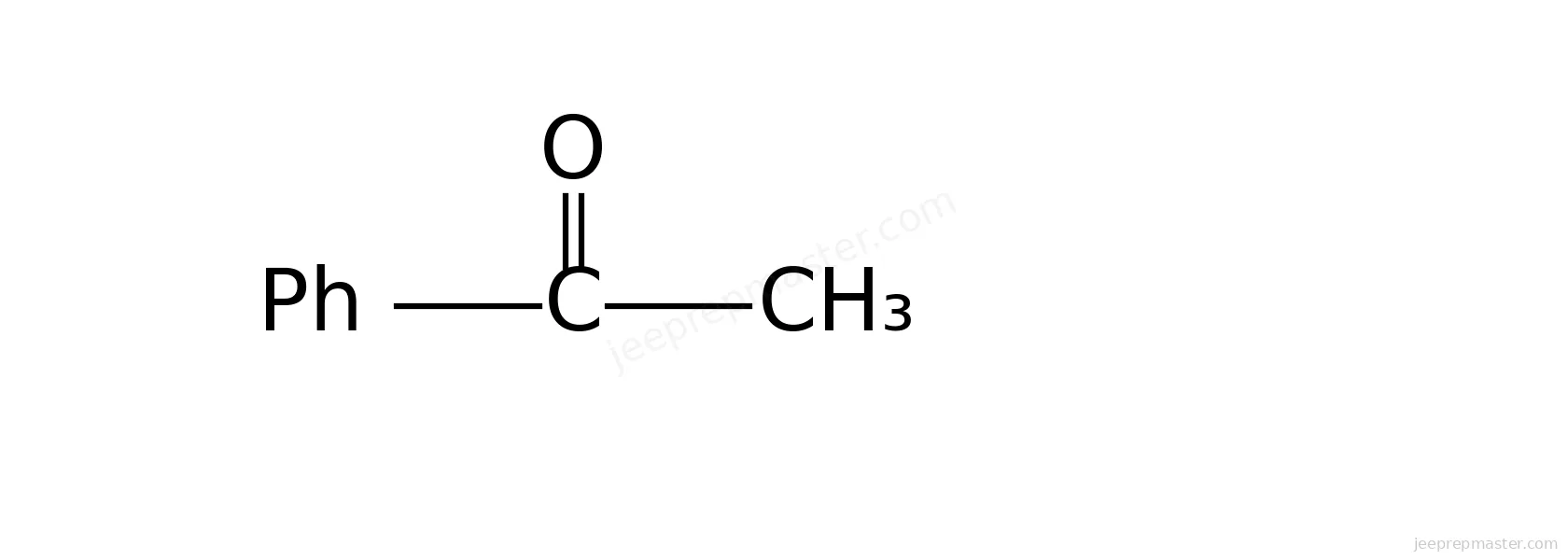
Ph–C(=O)–CH3→PCl5, ΔA→3 eq. NaNH2/NH3B →AcidifyC→1. B2H6; 2. H2O2/OH−D\begin{matrix} \text{Ph} –\text{C}\left( = \text{O} \right){ –\text{CH}}_{3} & \overset{\text{PCl}_{5},\ \Delta}{\rightarrow}A\overset{3\ \text{eq}.\ \text{NaNH}_{2}/\text{NH}_{3}}{\rightarrow}B \\ \ & \overset{\text{Acidify}}{\rightarrow}C\overset{1.\ \text{B}_{2}\text{H}_{6};\ 2.\ \text{H}_{2}\text{O}_{2}/\text{OH}^{-}}{\rightarrow}D \end{matrix}

Total number of sp2\text{sp}^{2} hybridised carbon atoms in product D is ________.
Chemical structure, acetophenone

Show answer and solution

Correct answer: 7

PCl5\text{PCl}_{5} replaces the ketone oxygen of acetophenone by two chlorines, giving A=Ph–CCl2–CH3,A = \text{Ph} –\text{CCl}_{2} –\text{CH}_{3}, a geminal dichloride.

Two equivalents of NaNH2\text{NaNH}_{2} eliminate two molecules of HCl to form the terminal alkyne Ph–C≡CH.\text{Ph} –\text{C} \equiv \text{CH}. The third equivalent removes its acidic terminal proton, giving B=Ph–C≡C−Na+.\text{B} = \text{Ph} –\text{C} \equiv \text{C}^{-}\text{Na}^{+}. Acidification restores C=Ph–C≡CH.\text{C} = \text{Ph} –\text{C} \equiv \text{CH}.

Under the anti-Markovnikov hydroboration–oxidation interpretation, C gives enol Ph–CH=CH–OH,\text{Ph} –\text{CH} = \text{CH} –\text{OH}, which tautomerizes to phenylacetaldehyde, D=Ph–CH2–CHO.D = \text{Ph} –\text{CH}_{2} –\text{CHO}. Bulky dialkylboranes normally provide better regiocontrol than the unmodified B2H6\text{B}_{2}\text{H}_{6} given here, so exclusive formation of this regioisomer should not be claimed from the stated reagent alone.

The phenyl ring contributes six sp2\text{sp}^{2} carbons, and the aldehyde carbonyl contributes one. The intervening CH2\text{CH}_{2} carbon is sp3.\text{sp}^{3}. Total sp2\text{sp}^{2} carbons =6+1=7.= 6 + 1 = 7. The alternative regioisomeric carbonyl product, acetophenone Ph–CO–CH3,\text{Ph} –\text{CO} –\text{CH}_{3}, also has six aromatic sp2\text{sp}^{2} carbons plus one carbonyl sp2\text{sp}^{2} carbon. Thus the numerical answer 7 does not depend on choosing between these carbonyl regioisomers.

More Hydrocarbons questions

All 49 Hydrocarbons questions