
JEE Main 29 January 2025 Shift 2: Physics Question 26
Given below are two statements. One is labelled as Assertion (A) and the other is labelled as Reason (R).
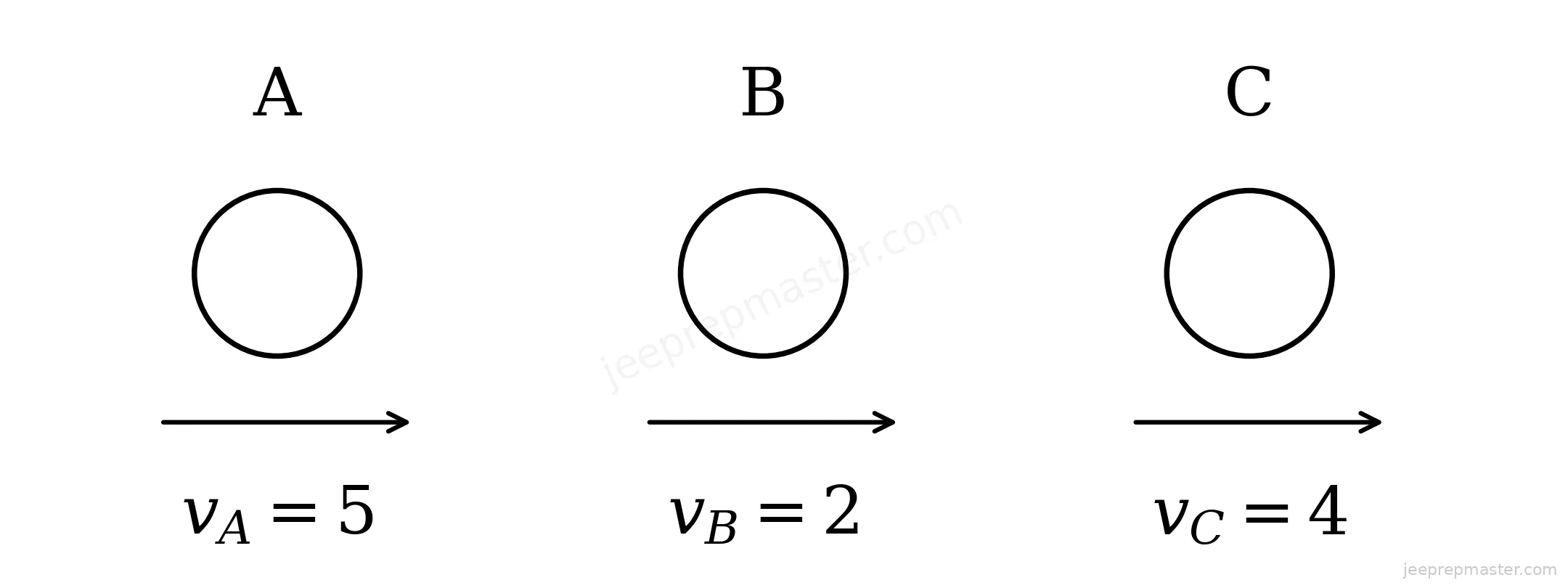
Assertion (A) :
Three identical spheres of same mass undergo one dimensional motion as shown in figure with initial velocities If we wait sufficiently long for elastic collision to happen, then will be the final velocities. Reason (R): In an elastic collision between identical masses, two objects exchange their velocities. In the light of the above statements, choose the correct answer from the options given below :
Show answer and solution
Correct answer: Option 1
For a one-dimensional elastic collision of equal masses, momentum conservation gives while restitution gives Solving yields and Thus reason (R) is true in the stated one-dimensional setting.
Initially the spheres are ordered A, B, C from left to right with speeds A catches B first; their velocity exchange gives B then catches C, giving
The speeds now increase from left to right, so no further collision is possible. The final velocities are and not the values in (A). Hence (A) is false and (R) is true: option (1).