JEE Prep Master

Reading mode

Text size

JEE Main 4 April 2026 Shift 2: Chemistry Question 64

HydrocarbonsSingle correct option+4 / −1

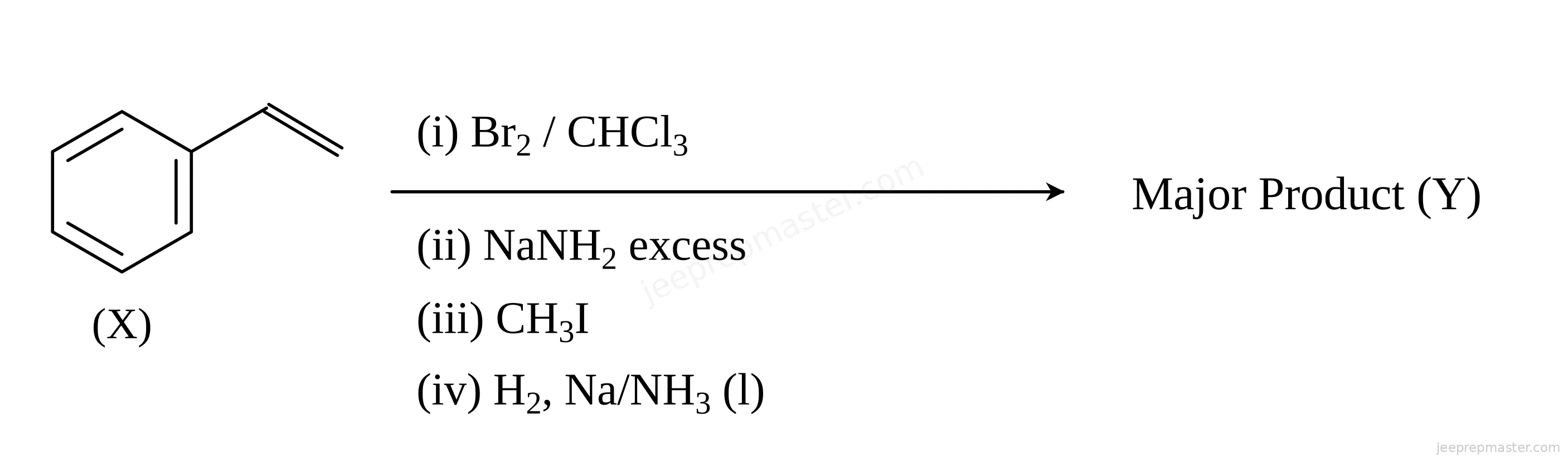
Styrene reaction scheme.

Compound (X)\text{(X)} is subjected to the sequence of reactions as shown above. Molar mass of the major product (Y)\text{(Y)} formed is __________ g mol−1\text{\_\_\_\_\_\_\_\_\_\_ g }\text{mol}^{-\text{1}}.

(Given molar mass in g mol−1 C\text{g }\text{mol}^{-\text{1}}\text{ C}:12\text{12}, H\text{H}: 1\text{1}, O\text{O}: 16)\text{16)}

Show answer and solution

Correct answer: Option 2

The starting compound X\text{X} is styrene, C6H5CH=CH2\text{C}_{\text{6}}\text{H}_{\text{5}}\text{CH=C}\text{H}_{\text{2}}. The given sequence is (i) Br2/CHCl3\text{(i) }\text{Br}_{\text{2}}\text{/CH}\text{Cl}_{\text{3}}, (ii) NaNH2\text{(ii) NaN}\text{H}_{\text{2}} excess, (iii) CH3I\text{) C}\text{H}_{\text{3}}\text{I}, (iv) H2\text{(iv) }\text{H}_{\text{2}}, Na/NH3(l)\text{Na/N}\text{H}_{\text{3}}\text{(l)}. Bromine adds across the side-chain double bond, giving C6H5CHBrCH2Br\text{C}_{\text{6}}\text{H}_{\text{5}}\text{CHBrC}\text{H}_{\text{2}}\text{Br}.

Excess NaNH2\text{NaN}\text{H}_{\text{2}} removes two equivalents of HBr\text{HBr} to form phenylacetylene, C6H5C≡CH\text{C}_{\text{6}}\text{H}_{\text{5}}\text{C}\equiv \text{CH}. Further base deprotonates this terminal alkyne to its sodium acetylide, C6H5C≡C−Na+\text{C}_{\text{6}}\text{H}_{\text{5}}\text{C}\equiv \text{C}^{-}\text{Na}^{+}.

The acetylide undergoes SN2\text{S}_{\text{N}}\text{2} alkylation with methyl iodide to give C6H5C≡CCH3\text{C}_{\text{6}}\text{H}_{\text{5}}\text{C}\equiv \text{CC}\text{H}_{\text{3}}. The Na/\text{Na/}liquid-NH3\text{-N}\text{H}_{\text{3}} dissolving-metal reduction then gives the trans alkene, (E)-C6H5CH=CHCH3\text{(E)-}\text{C}_{\text{6}}\text{H}_{\text{5}}\text{CH=CHC}\text{H}_{\text{3}}, whose formula is C9H10\text{C}_{\text{9}}\text{H}_{\text{10}}.

Its molar mass is 9(12) + 10(1) = 118 g mol−1\text{9(12) + 10(1) = 118 g }\text{mol}^{-\text{1}}, option 2\text{2}. The Na/NH3(l)\text{Na/N}\text{H}_{\text{3}}\text{(l)} step is a dissolving-metal partial reduction; H2\text{H}_{\text{2}} is not required for this step.

More Hydrocarbons questions

All 49 Hydrocarbons questions