
JEE Main 23 January 2026 Shift 2: Physics Question 36
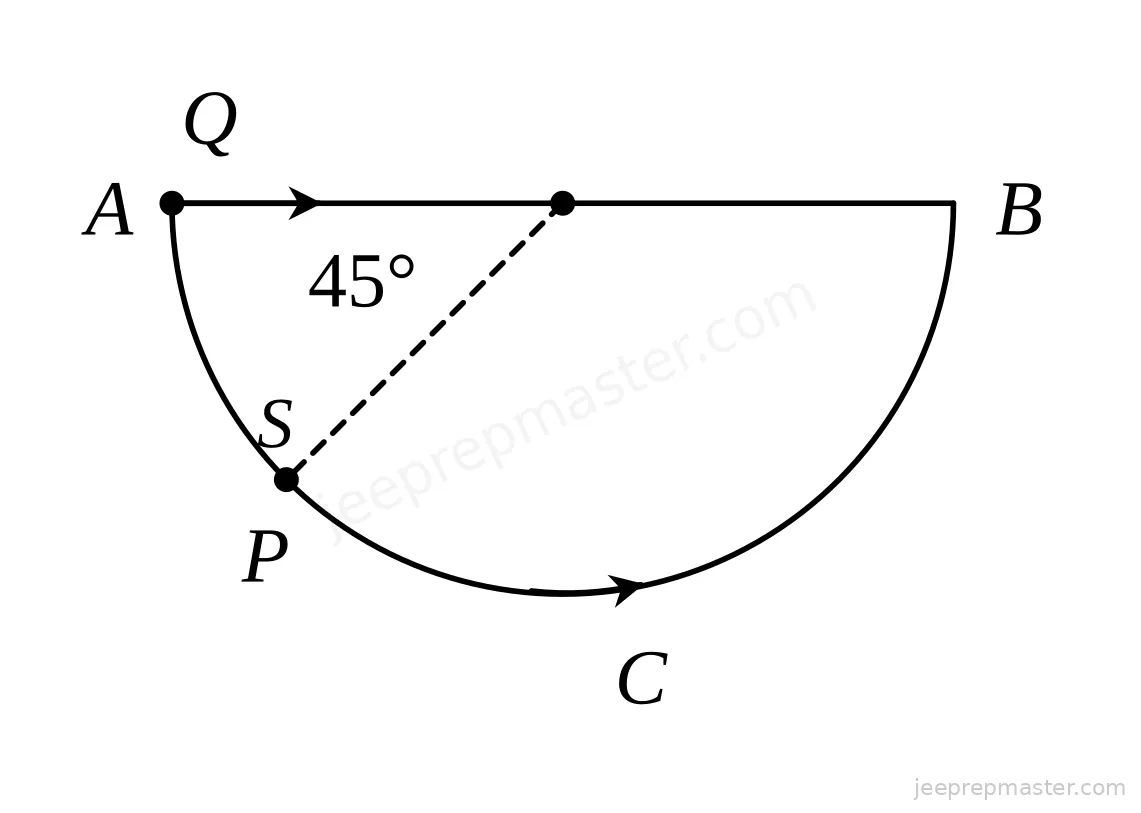
A bead sliding on a frictionless semi-circular string and it is at point at and at this instant the horizontal component of its velocity is . Another bead of the same mass as is ejected from point A at along the horizontal string , with the speed , friction between the beads and the respective strings may be neglected in both cases. Let and be the respective times taken by beads and to reach the point , then the relation between and is
Show answer and solution
Correct answer: Option 4
Assume constant speed: the circular track lies in a horizontal plane, or there is no tangential gravitational force. Let its radius be . At the radius is below the leftward diameter, so the tangent velocity is to the rightward horizontal direction.
If the horizontal velocity component of is , its full speed is . Starting at and moving through to , it traverses a central angle , so the arc length is .
Consequently . Bead travels the straight diameter at speed , so . Their ratio is . Therefore option follows.