
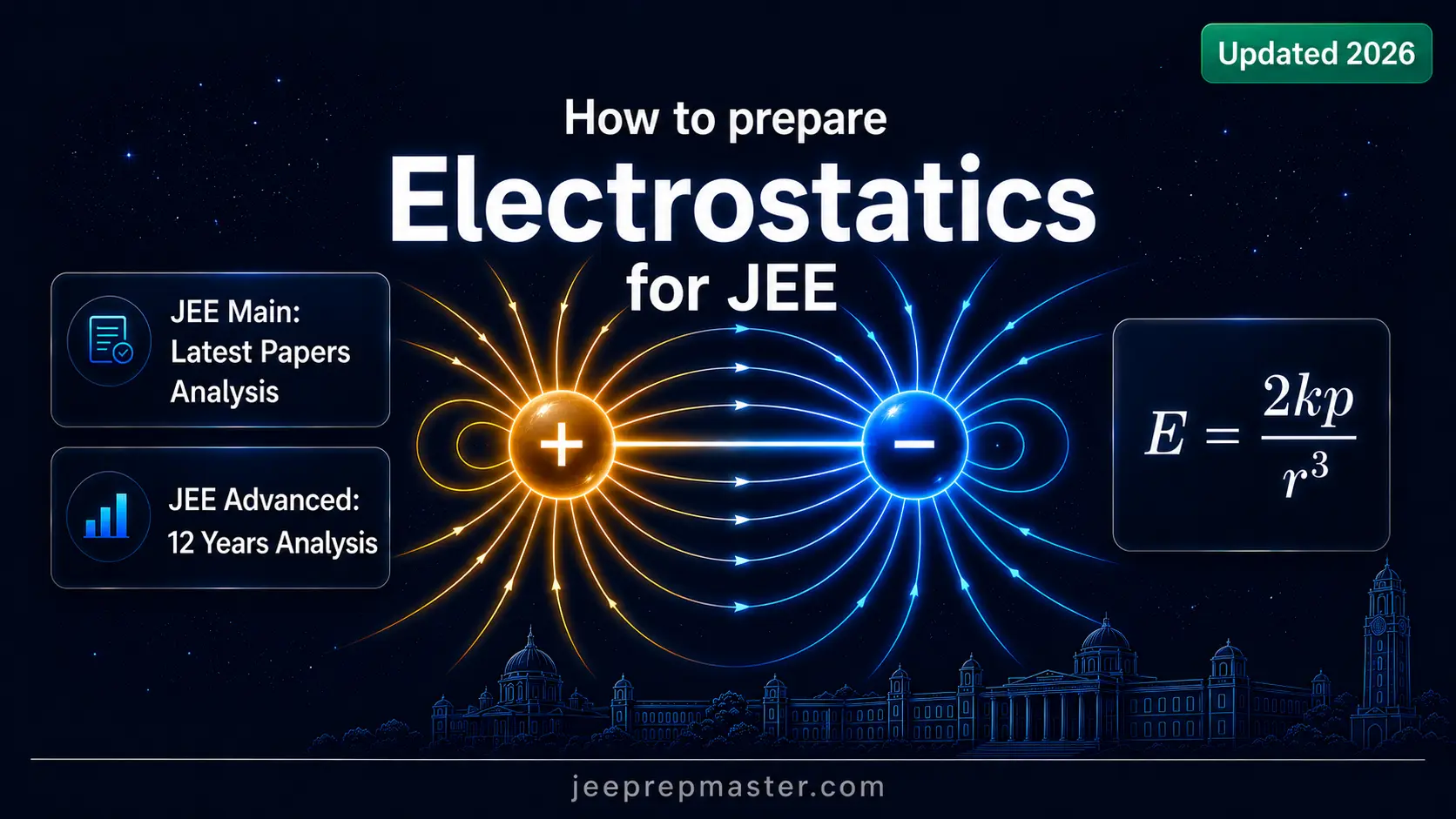
How to Study Electrostatics for JEE Main & Advanced: Complete PYQ Analysis 2024–2026

By MS Salim Sir | HOD Physics, JEE Prep Master | Ex-HOD Allen Kota | IIT BHU | Super 30
Updated June 2026 — Includes complete JEE Main 2024, 2025, 2026 + JEE Advanced 2014–2026 PYQ analysis
If you want to know how to study Electrostatics for JEE — Main or Advanced — this is the only guide you need. It is not built from a textbook. It is built from a complete PYQ analysis across three years of JEE Main (2024, 2025, 2026) and twelve years of JEE Advanced (2014–2026). Every priority, every warning, and every pattern here comes directly from what the examiners actually asked.
Electrostatics is the highest-weightage chapter in JEE Physics. In JEE Main 2026, 24 questions appeared from this one chapter across all sessions — a weightage of 5.47%. In JEE Advanced, it has appeared every single year since 2014 without exception. Most students study it wrong — memorising formulas linearly without understanding how JEE tests it. That changes with this guide.
According to the official NTA JEE Main website, the Physics paper carries 100 marks with 25 questions. Electrostatics alone accounts for 2–3 questions per session consistently — making it the single highest return-on-investment chapter in JEE Physics preparation.
At 4 marks per question in JEE Main, Electrostatics can swing 20–28 marks per session. In a paper where clearing cutoff sometimes requires just 5–10 extra marks, this one chapter is the difference.
Beyond raw marks, Electrostatics is the foundation of all Class 12 Physics. Current Electricity, Capacitors, Magnetic Effects, and parts of Modern Physics all build directly on concepts introduced here. Students who master Electrostatics find the rest of Class 12 Physics significantly easier. You can explore our JEE counselling page to understand how strong Physics preparation directly impacts your college options.
Key insight: Dipole and Potential together account for 26 out of 93 questions across three years — 28% of all questions from just two topics.
The unmistakable pattern: JEE Advanced tests one genuinely novel concept every year. 2024: dipole near shell. 2025: method of images. 2026: dipole dynamics + Apollonius locus. Prepare for something equally novel in 2027 — and the only way to handle a novel problem is to understand the physics deeply, not memorise patterns.
Why Electrostatics Demands More Time Than Any Other Chapter
The numbers speak clearly:| Exam | Year | Questions | Weightage |
|---|---|---|---|
| JEE Main | 2024 | ~32 across sessions | ~5.5% |
| JEE Main | 2025 | ~35 across sessions | ~5.8% |
| JEE Main | 2026 | 24 across sessions | 5.47% |
| JEE Advanced | Every year | 1–3 per paper | Always present |
1-on-1 Chapter Coaching
Struggling with Electrostatics?
Our student Ishaan Singh scored AIR 2046 in JEE Advanced after 1-on-1 Physics coaching with our faculty.
Book a session — cover complete theory, PYQs and exam techniques at your own pace.
Quick Overview
₹2,500
2 hrs
Mains Pack
₹9,999
10 hrs
Advanced Pack
₹13,500
14 hrs · HOD
✓ Free 30-min mentorship · ✓ 100% refund if not satisfied · ✓ 7-day WhatsApp access
How to Study Electrostatics for JEE Main: Complete 2024–2026 Strategy
Complete 3-Year Topic Frequency Map
After analysing every single Electrostatics question from JEE Main 2024, 2025, and 2026:| Topic | 2024 | 2025 | 2026 | 3-Year Total | Priority |
|---|---|---|---|---|---|
| Electric Dipole | 3 | 6 | 4 | 13 | 🔴 Highest |
| Electric Potential & PE | 4 | 4 | 5 | 13 | 🔴 Highest |
| Gauss’s Law & Flux | 5 | 4 | 2 | 11 | 🔴 Very High |
| Coulomb’s Law & E-field | 4 | 3 | 4 | 11 | 🟠 High |
| Conductors & Shells | 3 | 3 | 3 | 9 | 🟠 High |
| Assertion-Reason | 2 | 3 | 2 | 7 | 🟡 Medium |
| Motion of Charge in E-field | 3 | 2 | 2 | 7 | 🟡 Medium |
| Dipole SHM & Oscillation | 0 | 1 | 2 | 3 | 🟡 Rising Fast |
| Bubble Coalescence | 0 | 0 | 1 | 1 | 🟢 New — Will Repeat |
Zone 1 — Electric Dipole (Most Important for JEE Main)
The dipole is tested every year, in every session, in multiple forms. In 2025 alone: 6 questions. In 2026: 4 questions including two perpendicular-dipole superposition problems. It is not going away. Axial vs Equatorial field ratio (appeared 2024 and 2025): Axial field = 2kp/r³, equatorial field = kp/r³. Ratio = 2:1. On the equatorial line, potential = 0 always. On the axial line, E is parallel to p⃗. On the equatorial line, E is antiparallel to p⃗. This ratio has appeared in two consecutive years and will appear again. Torque and work done (2024 Q11, 2025 Q7): τ = pE sinθ. Work done rotating dipole from θ₁ to θ₂ = pE(cosθ₁ − cosθ₂). From equilibrium (0°) to antiparallel (180°): W = 2pE. Dipole oscillation — rising pattern (2025 Q14, 2026 Q4): T = 2π√(I/pE), so frequency f ∝ √E. JEE 2026 took this further: field changed from E₀x̂ to 2E₀(ŷ+ẑ), new magnitude = 2√2 E₀. Frequency ratio = (2√2)^(1/2) = 2^(3/4). Understand the derivation, not just the formula. Two perpendicular dipoles — confirmed 2026 pattern (appeared TWICE in 2026): JEE 2026 Q9 and Q15 both involved superposition of two dipoles with perpendicular axes. Resultant field = vector sum of individual fields. This appeared once in 2025 and twice in 2026. It is now a standard question type. Resultant dipole moment of charge system (2026 Q14): Three charges at given coordinates — find net dipole moment vector p⃗ = Σqᵢrᵢ⃗. Add component-wise. Draw the geometry first.Zone 2 — Electric Potential and Potential Energy (Equally Important)
V(x,y) → Electric Field using gradient — NEW, appeared TWICE in 2026: JEE 2026 Q2: V = 5(x²−y²), find E at (2,3). E_x = −∂V/∂x = −10x → at x=2: E_x = −20 V/m E_y = −∂V/∂y = +10y → at y=3: E_y = +30 V/m This was completely absent in 2024 and 2025. Appeared twice in 2026. Learn E⃗ = −∇V — it is now a confirmed JEE Main topic. Reverse Gauss: V(r) → charge enclosed (2026 Q12): V = ar³ + b inside sphere. Find Q inside unit sphere. Step 1: E = −dV/dr = −3ar² Step 2: Q = ε₀ × E × 4πr² = −12πaε₀r³ Step 3: At r=1: Q = 12πaε₀ New in 2026, combines calculus + Gauss’s Law + potential. Expect it in future papers. Equidistant points trap (2024 Q14, 2026 Q24): If two points are equidistant from a point charge, ΔV = 0 and work done = 0. Always calculate distances before starting. JEE 2026 Q24: A(4,4,2) → distance 6 from origin, B(2,2,1) → distance 3. NOT equidistant → work ≠ 0. PE in external field (2025 Q8, 2026 Q16): U_total = kq₁q₂/r + q₁V₁_ext + q₂V₂_ext. When E = A/r²r̂, the potential V = A/r (by integration). Appeared in two consecutive years — high-priority. Bubble coalescence — NEW in 2026 (Q19): n identical bubbles of radius R, charge q coalesce. R_new = n^(1/3)R (volume conservation), Q_new = nq. V_initial = kq/R, V_final = k(nq)/(n^(1/3)R) = n^(2/3)(kq/R). Ratio V_final/V_initial = n^(2/3). For n=3: ratio = 3^(2/3) ≈ 2.08.Zone 3 — Gauss’s Law with Tricky Geometry
Gauss’s Law questions in JEE are never straightforward. The examiner always adds a geometric twist. Here are all the tricks that have appeared across 2024–2026: The cube geometry (tested every year):- Charge at corner: shared by 8 cubes → Φ = q/8ε₀
- Charge at edge centre: shared by 4 cubes → Φ = q/4ε₀
- Charge at face centre: shared by 2 cubes → Φ = q/2ε₀
- Charge fully inside: Φ = q/ε₀
Zone 4 — Coulomb’s Law and Electric Field
Zero field point — appears every year: Between charges q and nq at distance d: zero-field point is at x = d/(1+√n) from q. q and 3q: x = d/(1+√3) — JEE 2024 q and 9q: x = d/4 from q — JEE 2025 Symmetric polygon — instant answer: For equal charges at vertices of any regular polygon, E at centre = 0 by symmetry. V = nkq/r. JEE 2026 tested pentagon (Q18) and hexagon (Q22). Recognise symmetry instantly — don’t waste 3 minutes calculating. Force in medium (2024 Q2): F’ = F × (r/r’)² × (1/K). New distance r/5, K=5: F’ = F × 25 × (1/5) = 5F. Connected spheres (2024 Q22, 2026 Q8): After connecting: Q₁/Q₂ = R₁/R₂ (same potential). Surface field ratio: E₁/E₂ = R₂/R₁.Zone 5 — Conductors and Shells
Three concentric shells (2026 Q13): For shells A, B, C (radii a < b < c, charges q₁, q₂, q₃): V_A = kq₁/a + kq₂/b + kq₃/c V_B = k(q₁+q₂)/b + kq₃/c V_C = k(q₁+q₂+q₃)/c Surface charge density σ ∝ 1/r (2025 Q19, 2026 Q8): On an irregular conductor, charge accumulates more at sharp points (smaller radius of curvature). For connected spheres: σ₁/σ₂ = R₂/R₁. Charged spheres in liquid — appeared TWICE in JEE 2024 (Q4 and Q17): K = ρ_sphere/(ρ_sphere − ρ_liquid). The equilibrium angle stays the same because the ratio of Coulomb force to effective weight remains unchanged. Students who miss the buoyancy term get a completely wrong answer.The 5 Brand New Patterns From JEE 2026
These were completely absent in 2024 and 2025. They are now confirmed topics for 2027 and beyond:- V(x,y) → E field using gradient — appeared twice. E⃗ = −∇V. Direct formula application, easy 4 marks once you know it.
- Dipole oscillation with changing field direction — f ∝ √|E⃗|. The direction of the new field matters for calculating the new magnitude.
- Two perpendicular dipoles superposition — appeared twice in 2026. Vector addition of individual dipole fields at a given point.
- Reverse Gauss: V(r) → Q enclosed — find E from V using differentiation, then apply Gauss to get Q. Combines calculus + Gauss’s Law.
- Bubble coalescence — charge conservation + volume conservation → potential ratio. Clean, predictable, will repeat.
How to Study Electrostatics for JEE Advanced: 2014–2026 Strategy
JEE Advanced is a fundamentally different exam. The same chapter — Electrostatics — is tested in a completely different way. Understanding this difference is the first step to preparing correctly.JEE Main vs JEE Advanced: How Electrostatics is Tested Differently
| Aspect | JEE Main | JEE Advanced |
|---|---|---|
| Question format | Single correct + Numerical | Multi-correct + Integer + Paragraph |
| Gauss’s Law | Standard symmetric geometries | Asymmetric non-standard surfaces, wire through shell |
| Dipole | Field/potential/torque/SHM | Dynamics with field switching, dipole near shell |
| Conductors | Connected spheres, surface σ | Grounded conductors, method of images |
| Charge distributions | Point charges, uniform shells | Variable density ρ(r), integration required |
| Difficulty | 40% direct formula | Near-zero direct formula questions |
| Core skill | Pattern recognition | Deep conceptual reasoning + multi-step calculation |
The 7 Advanced-Exclusive Topics (Never Tested in JEE Main)
Topic 1 — Method of Images / Grounded Conductor (Advanced 2025 P2 Q3): A positive charge Q at distance d from centre of grounded conducting sphere of radius R. The induced charge on the sphere = −(R/d)Q. When the sphere is grounded and the charge is moved further away, the induced charge on the sphere changes. This concept does not appear in NCERT or any JEE Main preparation material. It is a JEE Advanced exclusive that appeared in 2025 and will appear again. Topic 2 — Variable Charge Density with Integration (Advanced 2022 P2 Q6): ρ_A = kr inside sphere, ρ_B = 2k/r in outer shell. To find E at any point, integrate ρ over the volume: Q_enclosed = ∫ρ dV = ∫₀ʳ (kr)(4πr²)dr = πkr⁴. Then E = Q_enc/4πε₀r². JEE Advanced frequently gives ρ as a function of r and asks for E or V at various points. This requires comfort with integration — a skill JEE Main never tests for Electrostatics. Topic 3 — Dipole Dynamics with Time-Varying Field (Advanced 2026 P2 Q2): Dipole initially along x̂ at rest. Field Eĵ switched on at t=0, switched off at t=t_f when dipole is at angle θ_f. After the field is switched off, angular momentum is conserved — the dipole continues rotating. This requires combining torque, angular impulse, and energy conservation all in one problem. Purely Advanced territory. Topic 4 — Flux Through Non-Standard Gaussian Surfaces (Advanced 2017, 2018, 2019): Three consecutive years had multi-correct flux questions:- Cylindrical surface around a shell: flux depends on whether the cylinder intersects the shell
- Wire piercing spherical shell at 120° arc: enclosed charge = λ × (chord length through shell)
- Point charge just outside hemisphere: flux through curved surface ≠ flux through flat face
JEE Advanced Electrostatics Pattern by Year (2019–2026)
| Year | Question Type | Topic Tested |
|---|---|---|
| 2026 P2 | Multi-correct | Equipotential locus — Apollonius sphere |
| 2026 P2 | Multi-correct | Dipole dynamics with field switching |
| 2025 P2 | Multi-correct | Grounded sphere + method of images |
| 2025 P2 | Multi-correct | Six infinite sheets — field in regions |
| 2024 P2 | Multi-correct | Dipole near charged spherical shell |
| 2022 P2 | Multi-correct | Variable charge density ρ(r) with integration |
| 2022 P2 | Paragraph | Charged disk — particle motion along z-axis |
| 2022 P1 | Multi-correct | Hexagon charge configuration — find unknown charge |
| 2020 P2 | Multi-correct | Charged spheres in dielectric liquid |
| 2020 P1 | Paragraph | Charged particle projectile in uniform E field |
| 2019 P2 | Multi-correct | Dipole in uniform field — field at specific points |
| 2019 P1 | Multi-correct | Flux through cylindrical surface around charged shell |
The 6 Most Dangerous Mistakes (Both Exams)
Mistake 1: Confusing axial and equatorial dipole field direction Axial: E parallel to p⃗. Equatorial: E antiparallel to p⃗. Wrong direction = wrong answer even if calculation is perfect. This mistake appears in every batch every year. Mistake 2: Not checking equidistance before calculating potential If two points are equidistant from the source charge, ΔV = 0. Work done = 0. Always compute distances first — before writing a single formula. JEE tests this trap repeatedly. Mistake 3: Including charges outside the Gaussian surface Only enclosed charges contribute to flux. Zero contribution from outside charges — even nearby ones. Tested in JEE 2024 Q9, 2026 Q7, and consistently across Advanced papers. Mistake 4: Forgetting buoyancy in the sphere-in-liquid problem JEE Main tested this twice in 2024. Effective weight in liquid = mg − ρ_liquid × V × g. Without the buoyancy correction, the answer is completely wrong. K = ρ_sphere/(ρ_sphere − ρ_liquid). Mistake 5: Not knowing E⃗ = −∇V This appeared twice in JEE Main 2026 and was completely absent in all previous years. It is now a confirmed recurring pattern. E_x = −∂V/∂x, E_y = −∂V/∂y. Ignore this and lose 8 marks in the next session. Mistake 6 (Advanced only): Applying single-correct logic to multi-correct questions In JEE Advanced, typically 2–3 statements in a multi-correct question are correct. Students trained on JEE Main instinctively look for the “best” single answer. Evaluate each option independently. Never eliminate an option just because another one is correct.Salim Sir’s Strategy Note
“JEE Main and JEE Advanced test the same chapter but they test completely different abilities. In JEE Main, speed and pattern recognition matter — if you have seen the setup before, you solve it in 90 seconds. In JEE Advanced, pattern recognition is not enough. You must understand the physics so deeply that you can handle a setup you have never seen before. In 15 years of teaching, I have noticed one thing consistently: students who score full marks in Electrostatics are those who can explain every concept without a formula. The dipole is not a formula — it is a physical object with direction, torque, energy, and oscillation. Gauss’s Law is not a formula — it is a principle about what is enclosed. When you understand it that way, no new question can surprise you.” — MS Salim Sir, HOD Physics, JEE Prep Master Ex-HOD Allen Kota | IIT BHU Alumni | Super 30 | 15 Years Experience
Week-by-Week Study Order (Optimised for Both Exams)
Week 1 — Foundation (Common to both exams):- Coulomb’s Law and principle of superposition
- Electric field due to: point charge, dipole, ring, disc, infinite wire, infinite sheet
- Field line properties — JEE Main 2026 Q10 tested this directly as a statement-identification question
- Continuous charge distributions: linear (λ), surface (σ), volume (ρ) charge density
- Axial and equatorial field and potential — memorise the 2:1 ratio and direction
- Torque, work done, PE of dipole in uniform field
- Dipole oscillation SHM (basic T = 2π√(I/pE) and the 2026 changing-field version)
- Two perpendicular dipoles superposition (confirmed 2026 Main pattern)
- Resultant dipole moment of charge systems
- Advanced extra: Dipole dynamics with time-varying field (2026 Advanced)
- V from point charges, dipole, ring, shell
- E⃗ = −∇V gradient method — new JEE Main 2026 pattern, mandatory
- Potential energy in external fields
- Gauss’s Law — all symmetric distributions (sphere, cylinder, plane)
- Gauss’s Law — cube geometry (all four cases: corner, edge, face, body)
- Reverse Gauss: find Q from V(r) — new 2026 Main pattern
- Bubble coalescence — new 2026 Main pattern
- Advanced extra: Variable ρ(r) with integration, non-standard Gaussian surfaces
- Properties of conductors in electrostatic equilibrium
- Spherical shells — field and potential inside/outside/on surface
- Three concentric shells potential calculation
- Surface charge density: σ ∝ 1/r at sharp points
- Charged spheres in liquid (recurring JEE Main favourite)
- Energy conservation for approaching charged spheres
- Advanced extra: Method of images, grounded sphere near point charge
- Advanced extra: Overlapping spheres with opposite charge density
Formula Quick Reference (JEE Main + Advanced)
| Concept | Formula |
|---|---|
| Coulomb’s Law | F = kq₁q₂/r² |
| Dipole field — axial | E = 2kp/r³ |
| Dipole field — equatorial | E = kp/r³ |
| Dipole potential | V = kp cosθ/r² |
| Torque on dipole | τ = pE sinθ |
| PE of dipole in field | U = −pE cosθ |
| Dipole oscillation period | T = 2π√(I/pE) |
| Gauss’s Law | Φ = Q_enc/ε₀ |
| E from potential (gradient) | E⃗ = −∇V |
| Infinite sheet | E = σ/2ε₀ |
| Infinite wire | E = λ/2πε₀r |
| Outside spherical shell | E = kQ/r² |
| Conductor surface | E = σ/ε₀ |
| Connected spheres — charge ratio | Q₁/Q₂ = R₁/R₂ |
| Connected spheres — field ratio | E₁/E₂ = R₂/R₁ |
| Bubble coalescence | R_new = n^(1/3)R; V_ratio = n^(2/3) |
| Image charge (grounded sphere) | q_image = −(R/d)Q |
| Overlapping spheres field | E = ρd⃗/3ε₀ |
Recommended Books and Resources
HC Verma — Concepts of Physics Vol. 2: Best for building conceptual understanding of Electrostatics. Read Chapter 29 (Electric Field and Potential) and Chapter 30 (Gauss’s Law) fully — text first, then exercises. Chapters 4–6 of the exercises are JEE-level difficulty. DC Pandey — Electricity and Magnetism: Best for JEE Main level problem practice. Complete exercises in this order: Introductory → Exercise 1 (JEE Main level) → Exercise 2 (JEE Advanced level). Do not skip levels. NCERT Class 12 Physics Chapter 1 and 2: Mandatory for JEE Main. Multiple Assertion-Reason questions in JEE Main are directly based on NCERT text paragraphs. Read the full text, not just the examples. For JEE Advanced specifically: Irodov — Problems in General Physics, Electrostatics section (3.1 to 3.3). These are the closest in style and difficulty to JEE Advanced Electrostatics questions.How Electrostatics Connects to Other Chapters
Do not study Electrostatics in isolation. These connections will save you revision time and help you see the bigger picture: → Capacitors: Capacitance C = Q/V. Energy stored = ½CV² = Q²/2C. The entire Capacitors chapter is an application of electrostatic potential and field. Every capacitor formula derives from Electrostatics. → Current Electricity: Potential difference drives current. Resistance opposes charge flow. Even Ohm’s Law (V = IR) is a consequence of electrostatic potential difference driving charge motion. → Magnetic Effects of Current: Force on a moving charge in a magnetic field (qv×B) is conceptually analogous to Coulomb force. Field line concepts and superposition transfer directly. → Modern Physics — Bohr Model: Coulomb force provides centripetal force: kZe²/r² = mv²/r. The ratio of Coulomb to gravitational force between electron and proton — directly tested in JEE Main 2024 Q29 — uses pure Electrostatics formulas. Mastering Electrostatics now means you will understand Current Electricity faster, Capacitors become easy, and the Bohr model in Modern Physics requires no extra effort. This is why Electrostatics has the best return on investment of any chapter in JEE Physics.How JEE Prep Master Can Help You Master Electrostatics
At JEE Prep Master, our Physics faculty are IITians with 13–15 years of teaching experience at Allen, FIITJEE, and Narayana. We don’t just explain concepts — we work through problems with you until the chapter is truly done. Doubt Session Room: Stuck on any PYQ from this guide — a 2026 gradient question, a concentric shells problem, an Advanced method of images question? Book a 1-on-1 doubt session with Salim Sir or our team. Bring any material: NCERT, HC Verma, DC Pandey, your coaching module, any previous year paper. ₹1,500/hour. Book a doubt session → Chapter Teaching: Want Salim Sir to teach you the complete Electrostatics chapter from scratch — covering all foundations, all 2026 new patterns, and the Advanced-exclusive topics? Full chapter, JEE Main + Advanced level, structured sessions. 100% refund guarantee if you are not satisfied. Enquire about chapter teaching → JEE Test Series: Practice Electrostatics and all other chapters under real exam conditions. Track your accuracy, identify weak zones, and build the speed required to score in JEE Main. Explore the JEE Test Series →What’s Next in This Physics PYQ Series
- Current Electricity — Highest question count in JEE Main 2026 (28 questions). Complete PYQ analysis and study strategy coming next.
- Modern Physics — Photoelectric effect, Bohr model, nuclear physics. 3-year JEE Main + Advanced analysis.
- Magnetic Effects of Current — The chapter most students consistently underestimate.
- JEE Advanced Electrostatics Deep Dive — Dedicated full guide with detailed solution approaches for every Advanced-level pattern identified in this article.
Frequently Asked Questions about Electrostatics for JEE
Is electrostatics important for JEE Mains?
Yes — Electrostatics is the single highest-weightage chapter in JEE Main Physics. In JEE Main 2026, 26 questions appeared across all sessions, contributing 5.47% of the entire paper. No other single chapter matches this level of consistency. At 4 marks per question, Electrostatics alone can account for 20–28 marks per session.Is electrostatics important for JEE Advanced?
Equally important, but tested differently. JEE Advanced has had at least one Electrostatics question every single year since 2014. The questions are multi-correct type and significantly harder — testing deep conceptual understanding rather than formula recall. Topics exclusive to Advanced include method of images, variable charge density with integration, and dipole dynamics with time-varying fields.Is electrostatics tough for JEE?
For JEE Main: moderately difficult. About 40% of questions are direct formula application, 45% require one conceptual insight plus calculation, and 15% are genuinely hard multi-step problems. With the right study order, most students can score full marks on the easy and medium questions. For JEE Advanced: consistently challenging — nearly zero direct formula questions, all requiring multi-step reasoning and deep conceptual clarity.Can I skip electrostatics for JEE Mains?
Absolutely not. Skipping Electrostatics means losing 20–28 marks per session and destroying your foundation for Capacitors, Current Electricity, and Magnetic Effects — all three of which build directly on Electrostatics concepts. It is the single worst chapter to skip in all of JEE Physics preparation.What is the 80/20 rule for Electrostatics in JEE?
Spend 80% of your Electrostatics preparation time on three areas: Electric Dipole (complete — all sub-types), Electric Potential and PE (including the gradient method that appeared twice in JEE 2026), and Gauss’s Law with geometric tricks (cube geometry, partial enclosure). These three areas together cover 65%+ of all JEE Main Electrostatics questions from 2024–2026.Which topics are exclusive to JEE Advanced Electrostatics?
Seven topics never appear in JEE Main but are tested in Advanced: method of images for grounded conductors, variable charge density ρ(r) requiring integration, dipole dynamics with time-varying fields, flux through non-standard asymmetric Gaussian surfaces, dipole near a uniformly charged shell, overlapping spheres with opposite charge density, and Apollonius sphere as the equipotential locus.What new Electrostatics topics appeared in JEE 2026 for the first time?
In JEE Main 2026: finding E from V(x,y) using the gradient formula (appeared twice), dipole SHM with changing field direction, superposition of two perpendicular dipoles (appeared twice), reverse Gauss’s Law finding Q from V(r), and bubble coalescence for potential ratio. In JEE Advanced 2026: Apollonius sphere as the locus of equal-potential points, and dipole dynamics when the electric field is switched on and then off.PYQ Difficulty Classification (2024–2026)
One of the most practical things you can do before sitting down to study Electrostatics is understand exactly which types of questions are easy, which are medium, and which are genuinely hard. This classification is based on the actual JEE Main PYQs from 2024–2026. Easy — Direct formula application (~40% of questions): These questions test whether you know the formula and can substitute values correctly. No tricks, no geometric insight needed.- Electric flux as dot product of E and A vectors (E·A cosθ)
- Zero electric field point between two charges (use the standard ratio)
- Potential at equidistant points from a single charge (equals zero for two equal-opposite charges)
- Electric field inside a conductor (zero — always)
- Connected spheres charge ratio (Q₁/Q₂ = R₁/R₂)
- Symmetric polygon — E at centre (zero for equal charges)
- Dipole potential formula V = kp cosθ/r²
- Assertion-Reason on basic conductor properties
- Dipole field ratio at axial vs equatorial points (know direction AND magnitude)
- Gauss’s Law with partial charge enclosure (which charges are inside?)
- Potential energy in external field (three-term formula)
- V(x,y) → E field using gradient (new 2026 pattern)
- Work done moving charge — check equidistance first
- Charged spheres contact and separation problems
- Dipole torque and work done rotating
- Cube geometry flux (corner/edge/face/body)
- Connected spheres surface field ratio
- Bubble coalescence (volume + charge conservation)
- Two perpendicular dipoles — resultant field at a given angle condition
- Reverse Gauss: V(r) → Q enclosed via integration
- Dipole SHM with changing field direction — new effective field magnitude
- Three concentric shells — potential at all three radii simultaneously
- Energy conservation for two charged spheres approaching each other
- Charged oil droplets between plates (combine gravity, buoyancy, electric force)
- Electrostatic energy of charge configuration in non-uniform external field
Exam Day Strategy for Electrostatics Questions
Knowing the content is one thing. Executing under exam pressure is another. Here is exactly how to approach Electrostatics questions during the actual JEE Main exam. Step 1 — Read the question completely before looking at options (15 seconds): In JEE Main, the options are designed to trap students who half-read the question and jump to calculation. Always identify: what type of charge configuration is this? what is being asked (field, potential, force, flux, energy)? what is the geometry? Step 2 — Classify the question immediately (10 seconds): Ask yourself: is this a dipole problem? a Gauss’s Law problem? a potential problem? a conductor problem? Once you identify the category, the solution approach is clear. Most JEE Main Electrostatics questions fall cleanly into one category — don’t overthink. Step 3 — Write down the key formula first, then substitute (30 seconds for easy, 90 seconds for medium): Write the formula before substituting numbers. This prevents the common mistake of writing wrong numbers in the right formula. For potential questions: always write down the distances from the source charge before writing V = kq/r. Step 4 — Check symmetry before calculating (5 seconds): For any charge configuration arranged symmetrically around a point — pentagon, hexagon, square with equal charges — the electric field at the centre is zero. The potential is additive. Never calculate the field by components when symmetry gives you the answer for free. This alone saves 3–4 minutes in an exam. Step 5 — For Gauss’s Law questions, draw the enclosed region first: Before writing Φ = Q_enc/ε₀, draw a rough sketch showing which charges are inside the Gaussian surface. This prevents the most common Gauss’s Law error — including charges that are outside. Take 20 seconds to draw, save 4 marks. Step 6 — For numerical questions, check units before writing the final answer: JEE Main numerical questions frequently have answers in specific units (μJ, nC, V, N/C). Always check whether your calculation gives the right unit before finalising. Many students calculate correctly but write the wrong numerical value because they don’t convert units. Time allocation in the actual exam:- Easy Electrostatics questions: 60–90 seconds each
- Medium Electrostatics questions: 2–3 minutes each
- Hard Electrostatics questions: attempt after finishing all easy + medium; maximum 4 minutes
- If stuck after 3 minutes: mark for review, move on, come back later